



Traditional hiring methods like CVs and interviews fail to assess soft skills, which are critical to job performance. AI-powered assessments address this gap at scale. Companies like Bell use these tools to improve hiring speed, quality, and more. The future of recruiting is shifting from intuition to intelligence, with AI enabling more predictive, human-centered hiring.
Subscribe to our Newsletter
Like what you're reading? Leave us your email, and we'll deliver to your inbox on the last Thursday of the month.
Earlier this month, our CEO sat down with one of HR’s most infamous, Matt Alder, to talk skills alongside Veronique LaCasse, Senior RTO Manager at Bell. As a global telecommunications leader, LaCasse brings a unique perspective to the conversation since her function spans recruiting, training, and onboarding new agents.
So let’s get into it. Here are the top takeaways from our time with Bell on The Recruiting Futures podcast.
CVs and Interviews Can’t Measure Soft Skills
HiringBranch CEO, Stephane Rivard, opened the conversation with a scenario that many recruiters and hiring managers face. Two people were hired who had similar qualifications on paper. One performs on the job and the other doesn’t. Why? Because one has better soft skills than the other.
Traditionally, any evaluation of soft skills has been done through a CV or an interview in hiring processes in general, explains Rivard. When recruiters start hiring in high volumes it’s nearly impossible to measure skills effectively through traditional methods. That’s where AI and a data-driven approach can help recruiters, says Rivard.
LaCasse supported this notion, stating that even though the CV said a candidate was qualified, sometimes recruiters would end up interviewing someone who doesn’t have the minimal requirements. She points out that while they still have CVs and interviews, she is able to measure soft skills using AI assessments from HiringBranch in Bell’s hiring process. The skills assessments speed up the hiring process, says LaCasse, while also improving the candidate quality, and in turn making a better use of the recruiters time. In Bell’s case, AI isn’t replacing recruiters, it’s making them more effective.
The Right AI Doesn’t Detract From the Candidate Experience
Candidates like AI skills assessments. Even though they seem to be allergic to AI interviews, as Alder pointed out, AI skills assessments like the one from HiringBranch are producing a different result by simulating real-world scenarios. These types of mock job experiences surface the candidates' soft skills in a more natural way than an interview, Rivard explained.
He also mentioned that for the candidate, these types of simulations set expectations of what the job entails, especially because it can be personalized to all the roles being hired for. And from this point of view, an AI skills assessment that gives candidates a preview of the job is very different from what an AI interview entails. In Bell’s case, even though an AI skills assessment is part of the process, it’s so important that candidates know recruiters are there throughout the process, advocating for them.
Predicting Performance is Possible with Soft Skills Assessments
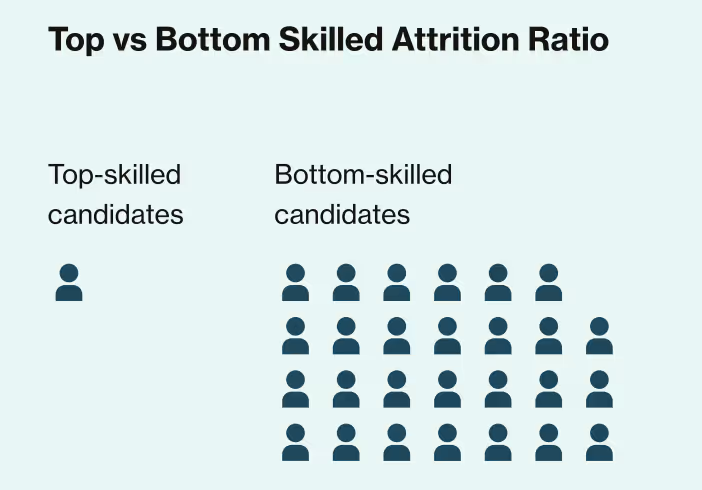
If large companies like Bell can discern top performers from bottom ones pre-hire, then the notion of predicting performance at the hiring stage is not only possible, it’s being put into practice.
The HiringBranch soft skills assessment is based on an industry and a role, and often customized to the employer. Rivard explains that if the employee is basically doing the job, the assessment acts like a real performance evaluation, and that’s why it works. For example, there are different scenarios that a candidate would be put in for a sales role than in a healthcare service role. Similarly, the soft skills required to be successful in these positions would be very different.
This may seem logical, but often recruiting decisions aren’t standardized and can be based on gut instincts. Alder Alder explains, “In an era where performance metrics drive every business decision, recruiting often remains stubbornly intuition-based.”
“In an era where performance metrics drive every business decision, recruiting often remains stubbornly intuition-based.”
From where LaCasse sits, she is uniquely positioned to see how recruiting, training, and onboarding influence each other. She is able to gather performance data and feed that back into the other sectors of her department to improve decision-making. For example, Bell can see if training is going well, then it means recruiting was successful. It’s easy to understand if the recruiter made the right decision right away, and to share data within one department easily. Similarly, it’s easier for the cross-functional team to make global conclusions on performance from pre-hire to on-the-job because everything is data-driven. This is truly innovative given how lax hiring decisions can be. For the recruiter, it’s reassuring to have the data that the risk they took in hiring a candidate paid off.
What Does the Future of Recruiting Look Like?
Everyone knows AI is reshaping talent acquisition and assessments. It’s changing from being reactive to being predictive and performance-driven, says Rivard. His predictions for the future is that recruiting will no longer about CVs and hiring on gut. We are entering an era where AI models can proactively identify the right talent with precision, he says. We will see more of AI being used to identify fit, skills gaps, role matching, and to reduce bias at scale. Rivard predicts organizations will use AI to move from hiring intuition to intelligence. “The future of talent acquisition is more human, not less,” says Rivard.
The conversation revealed just how advanced Bell’s hiring system is in today’s world of recruitment. And that’s because it is AI and performance-driven, but still very much in the control of the recruiters.
- Stephane Rivard
After listening to LaCasse talk about Bell’s innovative and effective hiring practices, Alder was impressed to see how human the decision-making was at scale, even though an AI skills assessment was being used in the process.
Listen to the full podcast episode here.
Image Credits
Feature Image: Unsplash/Sam McGhee




.svg)