



Personality interview questions make sense at first glance, but experts warn they shouldn't be used for hiring. Read on to learn why these types of evaluations are best suited for professional development and what employers should use for hiring instead.
Subscribe to our Newsletter
Like what you're reading? Leave us your email, and we'll deliver to your inbox on the last Thursday of the month.
Personality interview questions offer no guarantees to recruiters looking for high-quality candidates. Getting to know about a candidate’s personality may feel essential at first, but on the other hand, recruiters who use personality as their primary mid-funnel weathervane don’t necessarily end up finding the highest-quality candidates. Even the right combination of personality interview questions in a test or interview will not predict job performance.
What is a Personality Interview or Assessment?
Personality interview questions are used to measure the characteristics of a candidate in a hiring process.
The American Psychological Association defines personality as follows:
“The enduring configuration of characteristics and behaviour that comprises an individual’s unique adjustment to life, including major traits, interests, drives, values, self-concept, abilities, and emotional patterns. Personality is generally viewed as a complex, dynamic integration or totality shaped by many forces, including hereditary and constitutional tendencies; physical maturation; early training; identification with significant individuals and groups; culturally conditioned values and roles; and critical experiences and relationships.”
There are dozens of possible personality interview questions that could be asked in an in-person interview or through the administration of some kind of test in order to understand one's personality.
Popular Personality Interview Questions
While prepping for a job interview, candidates spend a lot of time researching sample questions and practicing suitable answers. Recruiters use these questions to assess both good and bad personality traits. Good personality traits can include integrity, responsibility, and more. Bad ones would be more along the lines of arrogance and carelessness. Recruiters may be wondering what the best personality interview questions to ask are, and there is no one right answer. Common personality interview questions include:
- What motivates you?
- How do you deal with conflict?
- How do you handle criticism?
- Describe yourself in three words.
What is your communication style?
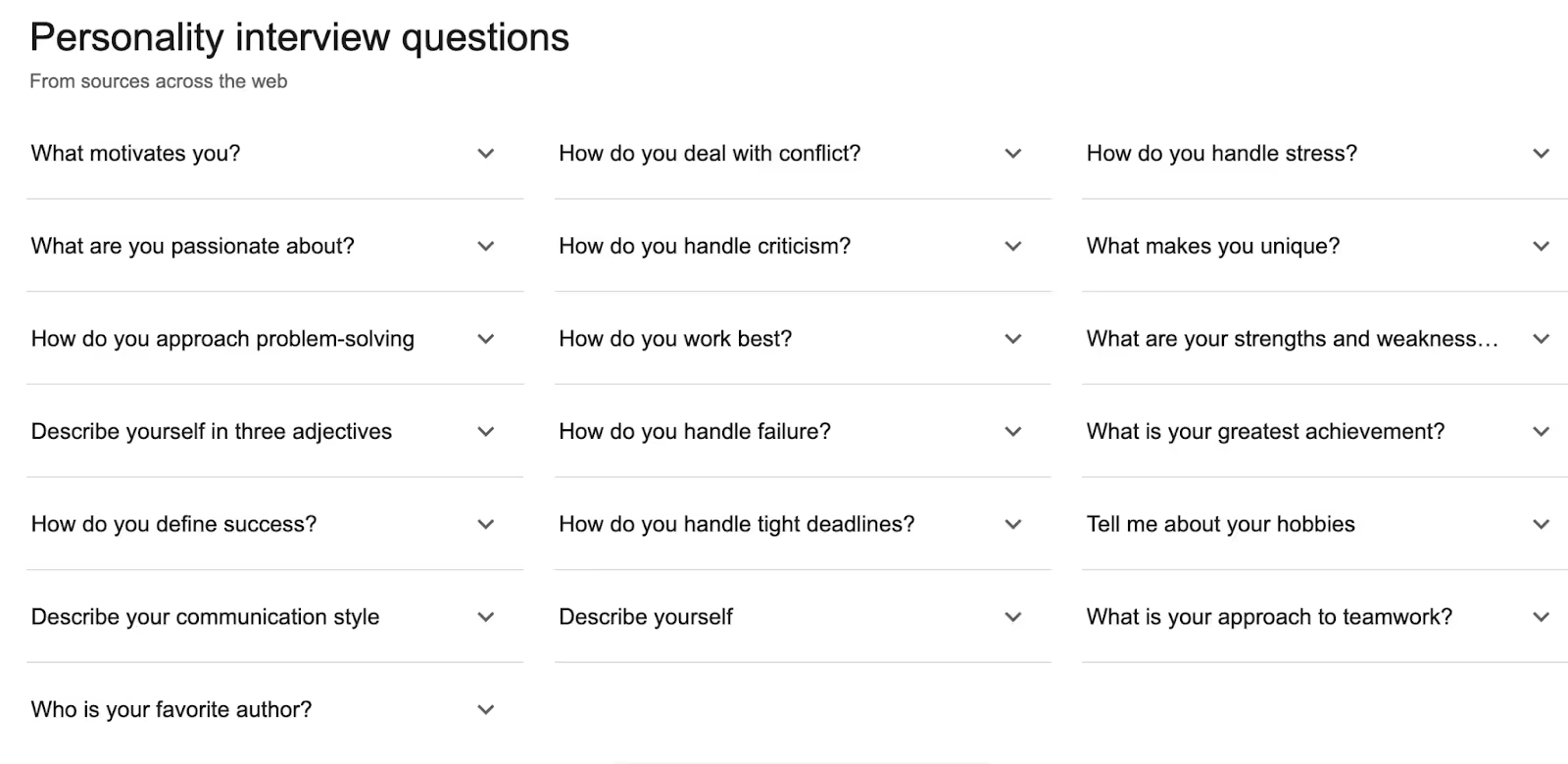
If you search for “personality interview questions” on Google, you will get immediate suggestions, like:
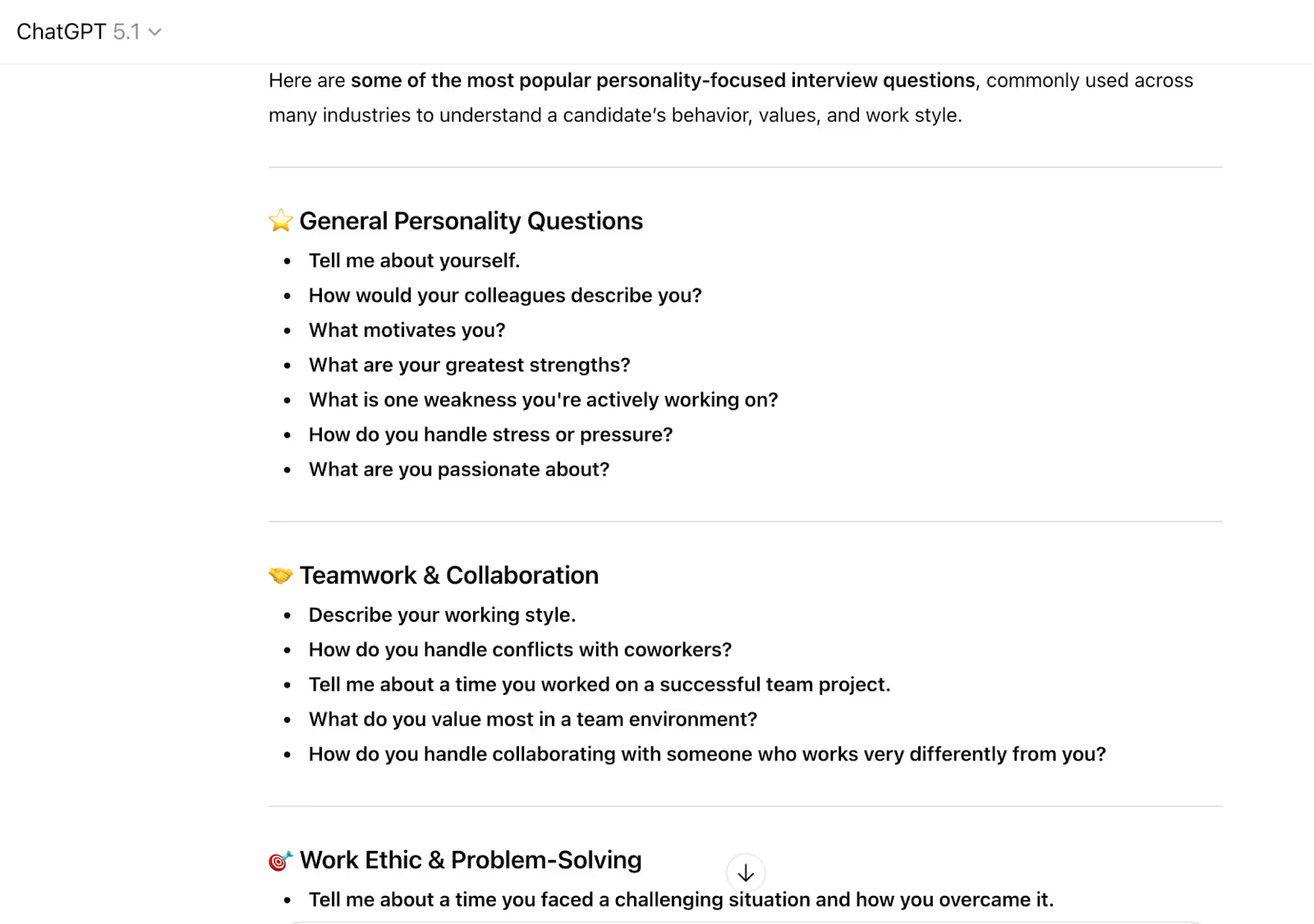
If you search ChatGPT, you’ll get the following suggestions, and more:
Recruiters may also rely on existing tests like the Big Five (OCEAN) test offered by companies like Test Gorilla.
Why Personality Interviews and Tests Fail Employers
Unfortunately, personality tests like the Big Five (OCEAN) are considered flawed because they oversimplify personality, don't account for cultural differences, and may not be reliable because information is self-reported and the fact that personalities can change over time. Critics argue the model doesn't capture the complexity of human behavior, lacks causal explanations, and its results aren't always practical for predicting specific actions in real-life situations. Here are the top reasons why personality tests fail:
- Candidates can easily prepare rehearsed answers
Search engines and interview prep resources (as seen above) make it simple to craft ideal responses. - Personality tests often assess likeability—not capability
Charismatic candidates can “pass” personality interviews while lacking core job skills. - Personality interview questions and answers are highly subjective
Interviewers interpret responses through personal bias and existing team norms. - Personality tests often rely heavily on self-reporting
Self-report bias and social desirability bias undermine reliability. - False Negatives
Quiet, introverted, or neurodiverse candidates may be unfairly screened out despite strong job skills. - Legal Risk
If personality tests are used in a way that disproportionately impacts certain demographic groups, they may violate employment law standards (e.g., EEOC guidelines). - Poor Predictive Accuracy
As established across multiple studies, personality does not equate to performance!
Additional research reinforces these concerns. According to the American Psychological Association, personality tests are not designed to predict work performance. A meta-analysis published in Personnel Psychology found that personality tests predict less than 5% of job performance variability. The Journal of Applied Psychology notes that personality assessments are more effective for development, not selection.
Even with a standardized set of personality interview questions applied at scale, recruiters aren’t getting candidate data that can help them make better hiring decisions. While personality can influence how a person will behave at work, recruiters often make the mistake of hiring candidates who share like-minded personality traits. Even worse, employers can actually increase their risk if they rely on personality tests as the primary proxy for a hiring decision.
Personality-Based Versus Skills-Based Hiring
Recruiters can also make the mistake of trying to use a personality test in pursuit of soft skills. The key difference between personality traits and soft skills is as follows:
Personality
- Innate traits & tendencies
- Harder to define
- Fluid and changeable
- Weak predictor of performance
- Typically self-reported
Soft Skills
- Observable workplace behaviours
- Easy to operationalize & assess
- Can be trained, coached, and improved
- Strong predictor of performance
- Demonstrated through behaviour
With as many as 84% of enterprises turning towards skills-based hiring, soft skill evaluation is becoming more important than personality evaluation. However, unlike personality tests, soft skills assessments have been proven to predict performance on the job.
To move beyond personality-based assessment, companies should adopt a skills-first hiring model built on objective data. Start with role competencies and define the behaviors, skills, and outcomes that lead to success.
Work simulations can take skills assessments to the next level. For example:
- A sales role might include a mock discovery call
- A customer support role might include responding to a sample ticket
- An analyst role might complete a mini-case study
Beyond this, hiring teams have to use consistent scoring rubrics to help ensure every candidate is evaluated fairly and consistently.
Ask Better Questions, Make Better Hires
Personality interview questions may feel helpful, but they provide no guarantees in identifying high-quality talent. Even the most widely accepted personality assessment frameworks are limited in predictive accuracy, subject to bias, and often misused.
In today’s hiring landscape, where skills-based hiring is rapidly becoming the standard, recruiters should pivot toward scientifically validated, behavior-based evaluation strategies. These methods provide richer insights, reduce bias, and improve long-term hiring outcomes.
Personality interviews can stay, but only as development tools, not hiring decision-making mechanisms.
Image Credits
Feature Image: Unsplash/Nguyen Dang Hoang Nhu
Image 1: Screenshot via Google Search
Image 2: Screenshot via ChatGPT





.svg)