

There’s no single best AI skills assessment tool. Only the right fit for what you’re measuring. Compare six leading platforms for hiring and upskilling.
Subscribe to our Newsletter
Like what you're reading? Leave us your email, and we'll deliver to your inbox on the last Thursday of the month.
TL;DR: AI skills assessments are AI-scored evaluations that measure role-critical skills to support faster, fairer hiring and upskilling at scale. The best platform depends on the intended use case (e.g., assessing soft skills using AI vs. general AI literacy) and hiring volume.
AI skills assessments offer a structured, scalable way to measure soft and hard skills that predict on-the-job success.
Some platforms analyze how candidates communicate under pressure and de-escalate angry customers. Others test how well your devs code alongside AI itself. The best assessment choice depends on which competencies you’re trying to evaluate.
In this post, you’ll learn about six leading tools and how to confidently choose the right one to meet your hiring and upskilling goals.
What Are the Best AI Skills Assessment Platforms?
TA teams seeking the best AI skills assessment platforms often look for either a tool that uses AI to assess someone’s skills or one that tests their AI-specific skills.
Here are six of the top platforms from both categories (in no particular order):
AI-powered skills assessment platforms
- HiringBranch. Best for evaluating communication and soft skills like empathy and active listening by scoring conversational responses.
- TestGorilla. Best for broad, prebuilt libraries covering personality and hard skills tests.
- Vervoe. Best for spreadsheet tasks, presentations, and coding challenges.
Assessment platforms that test AI proficiency
- CodeSignal. Best for measuring how candidates and team members use AI in role-specific tasks.
- HackerRank. Best for testing how developers work with AI agents and guarded AI tools during coding workflows.
- iMocha. Best for evaluating foundational AI literacy to advanced neural networks.
Below, we break each tool down in a little more detail.
1. HiringBranch: Best for Evaluating Soft Skills and Communication
HiringBranch is an AI-powered skills assessment platform that uses open-ended voice and chat conversations to score soft skills like acknowledgment, judgment, and active listening.
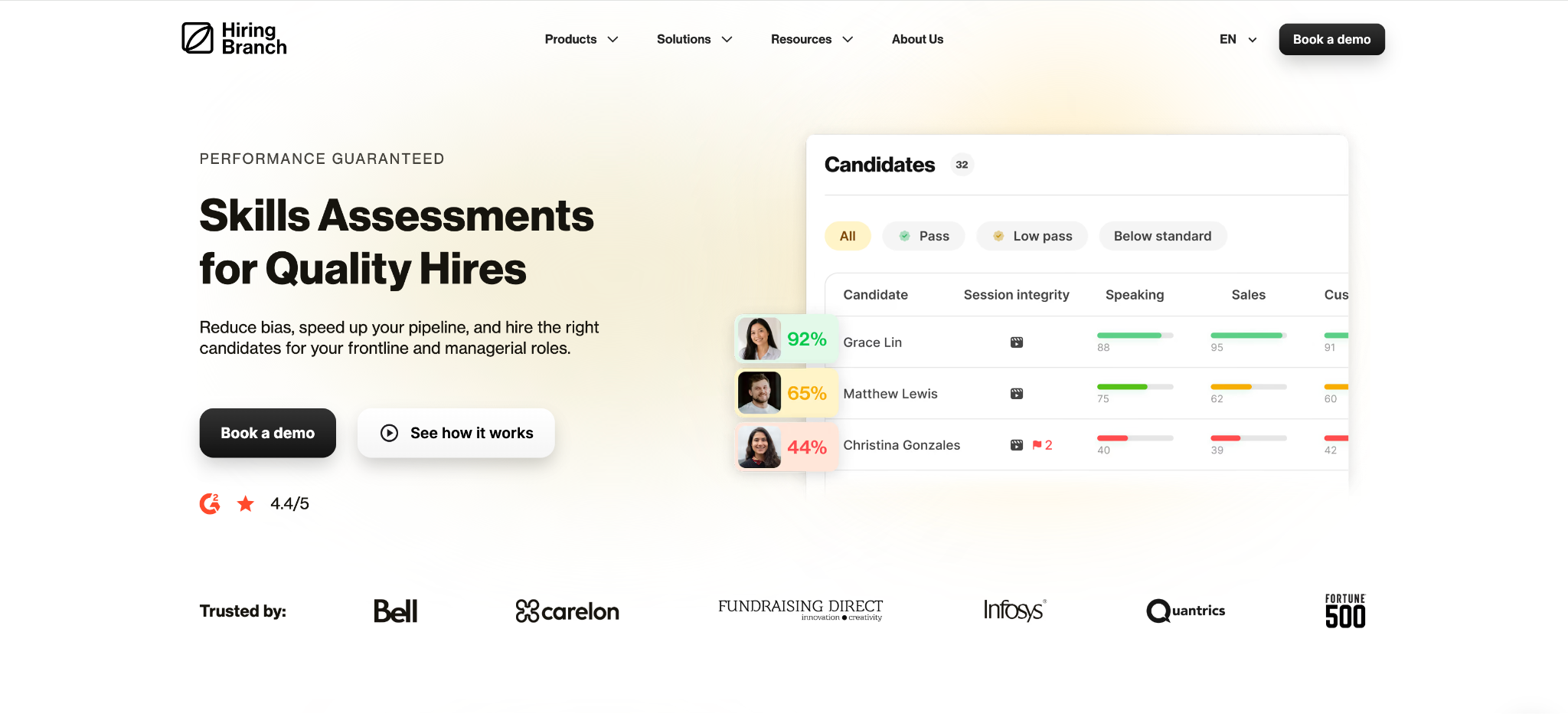
High-volume hirers in customer-facing roles (e.g., contact centers or frontline healthcare workers) benefit most, where communication quality directly impacts performance.
AI algorithms assess role-critical skills, language comprehension, and fluency with 98% accuracy. It also doubles as an upskilling tool, letting HR teams run tailored scenarios against existing team members to spot coaching gaps.
HiringBranch can also create branded assessments tailored to specific business needs and role requirements. Eligibility questions and other add-ons can be easily built into any assessment experience.
Key features include:
- Candidates respond via voice or text to open-ended scenarios (no multiple-choice)
- Proprietary AI trained on conversational datasets
- Job preview format lets candidates experience a realistic work scenario before they’re hired
- SOC 2, GDPR, and NYC Law 144-compliant infrastructure for handling assessment data at scale
- Used by contact centers and Fortune 1000 enterprises for high-volume, customer-facing AI hiring
Not the best fit for: Hiring for technical roles where soft skills and communication aren’t the primary predictors of success.
2. TestGorilla: Best for Personality and Hard Skills Tests
TestGorilla is a pre-employment testing platform with a large library of prebuilt tests covering personality, cognitive abilities, and job-specific hard skills.
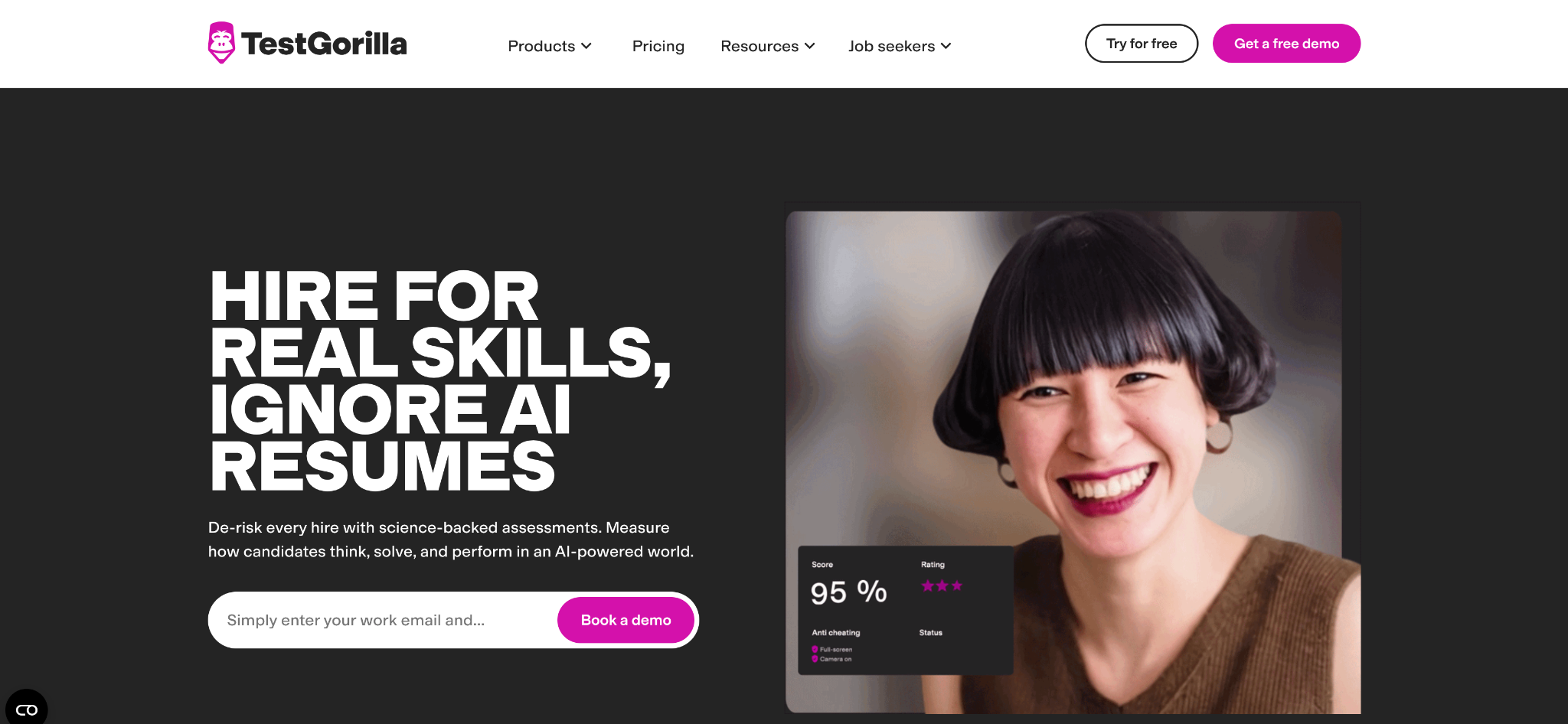
Users can choose to turn on AI scoring, which evaluates open-ended responses against structured criteria. (Plus, edit or override anything based on its reasoning.)
It’s best suited to TA teams who want a self-service platform for broader hiring across many different roles and departments.
Each test is around 10–30 minutes and is often multiple-choice. Some include practical coding environments or interactive simulations.
TestGorilla’s key features include:
- Some 350+ prebuilt, scientifically validated tests spanning cognitive, personality, technical, and language skills
- A five-pillar framework for assessing AI fluency
- Ability to create custom questions or choose recommended versions
- Every AI-suggested score shows its reasoning and can be edited or overridden by recruiters
- Up to five tests can be combined into a single assessment
Not the best fit for: Companies that want highly bespoke, company-specific workflow tests rather than standardized, general aptitude benchmarks.
3. Vervoe: Best for Spreadsheet, Presentation, and Coding Tasks
Vervoe is an AI-powered assessment platform that scores candidates on immersive, job-simulation tasks like spreadsheet work and coding challenges.
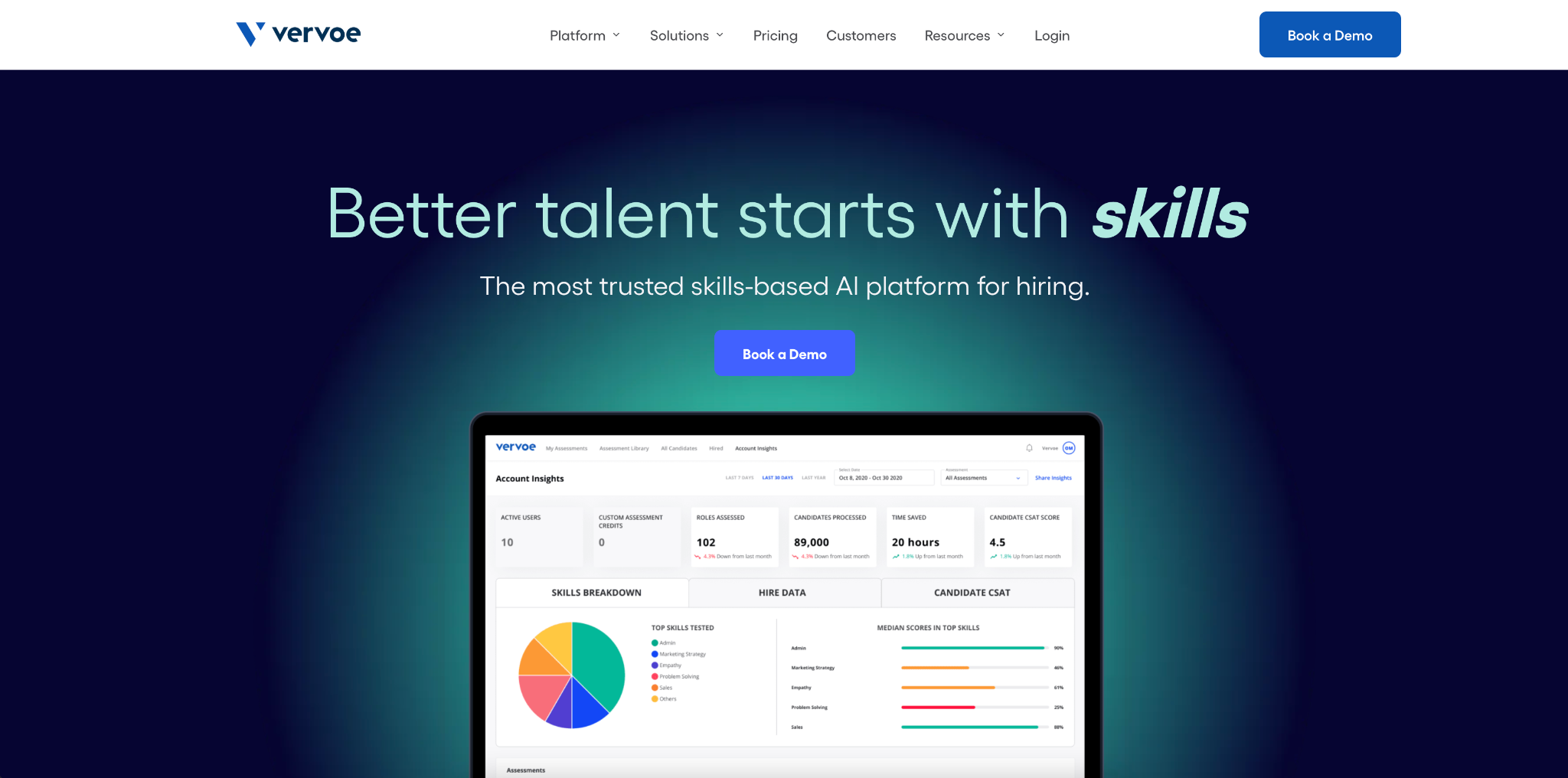
AI grading helps teams evaluate daily work at scale. Three models assess applicants across performance, targeted knowledge checks, and working style.
Every competency gets a percentage score so reviewers can spot where someone’s skilled in qualification, for instance, but needs more work in CRM proficiency.
The AI chatbot also turns screening and information collection into a conversation, with clear outcomes after candidates answer all questions.
Vervoe’s key features include:
- Around 300+ ready-made assessment templates
- Coding challenges available across eight programming languages
- Embedded live spreadsheet and presentation tasks
- Conversational AI chatbot that reveals each person’s communication skills
- AI scoring independently audited for bias and fairness by Holistic AI
Not the best fit for: Nuanced reads on specific soft skills, as tests are mostly better for breadth of coverage and a multiple-choice format.
4. CodeSignal: Best for Agentic AI Assessments
CodeSignal is an agentic skills intelligence and validation platform that helps companies test and develop their AI skills.
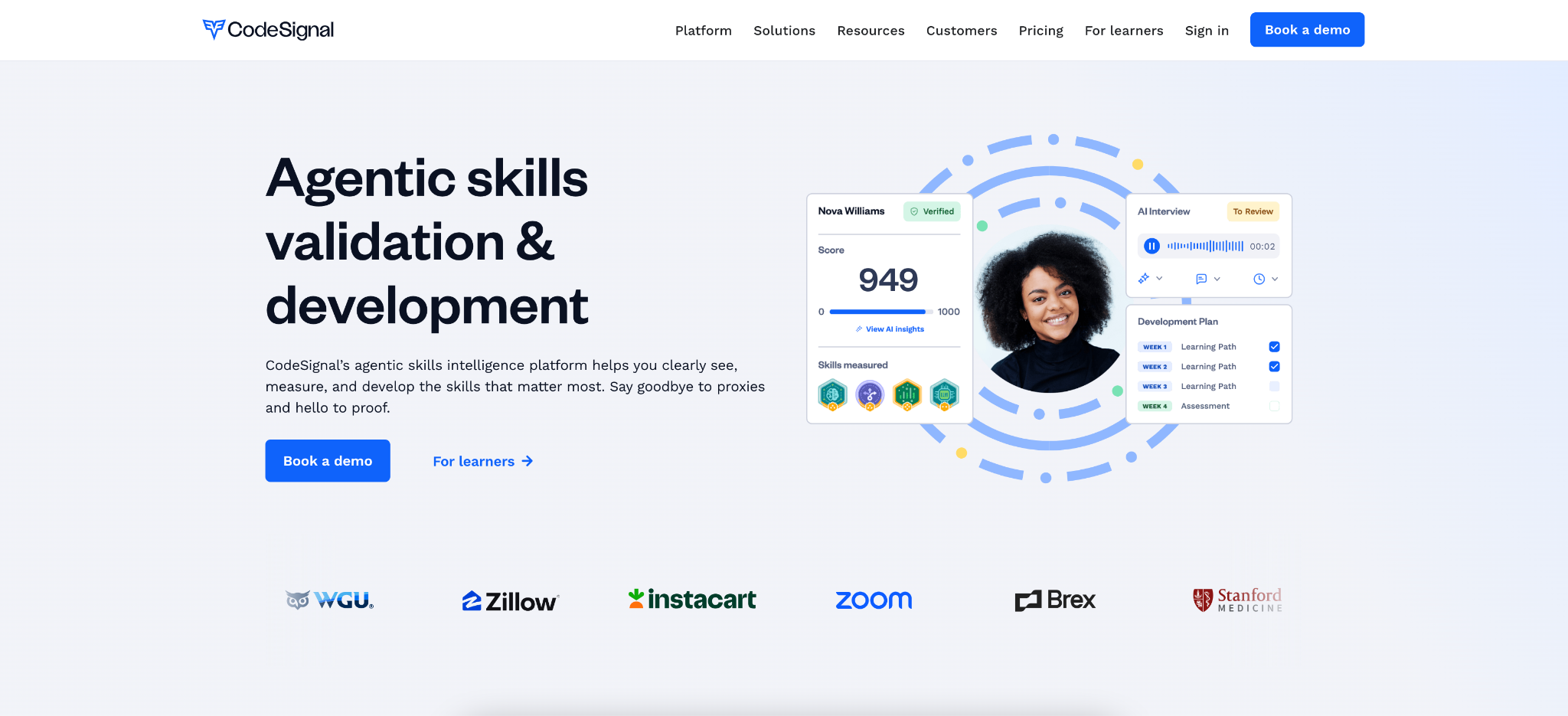
Potential hires and team members complete tasks that mirror real work, such as prompt engineering and AI-assisted coding.
The platform covers competencies from foundational to advanced, depending on the stage companies are at.
CodeSignal’s roots in technical assessment make it a strong fit for engineering hiring pipelines. But it’s equally effective for more general upskilling and reskilling as AI tools continue to reshape day-to-day work.
Key features include:
- Targeted AI assessments (e.g., Literacy, Prompt Engineering, and AI Researcher) for different skill levels
- Measures how candidates use AI appropriately in realistic tasks
- Hands-on tests include AI chat interactions, prompt design challenges, and AI-assisted coding exercises
- Native AI can auto-generate role-specific tests
- Options to choose which LLMs power assessments to meet security and compliance requirements
Not the best fit for: Teams hiring senior engineers to handle complex design workflows that want to assess software-building skills.
5. HackerRank: Best for Testing How Developers Work With AI Agents
HackerRank is a technical assessment platform for developers that uses AI models to assist recruiters with scoring.
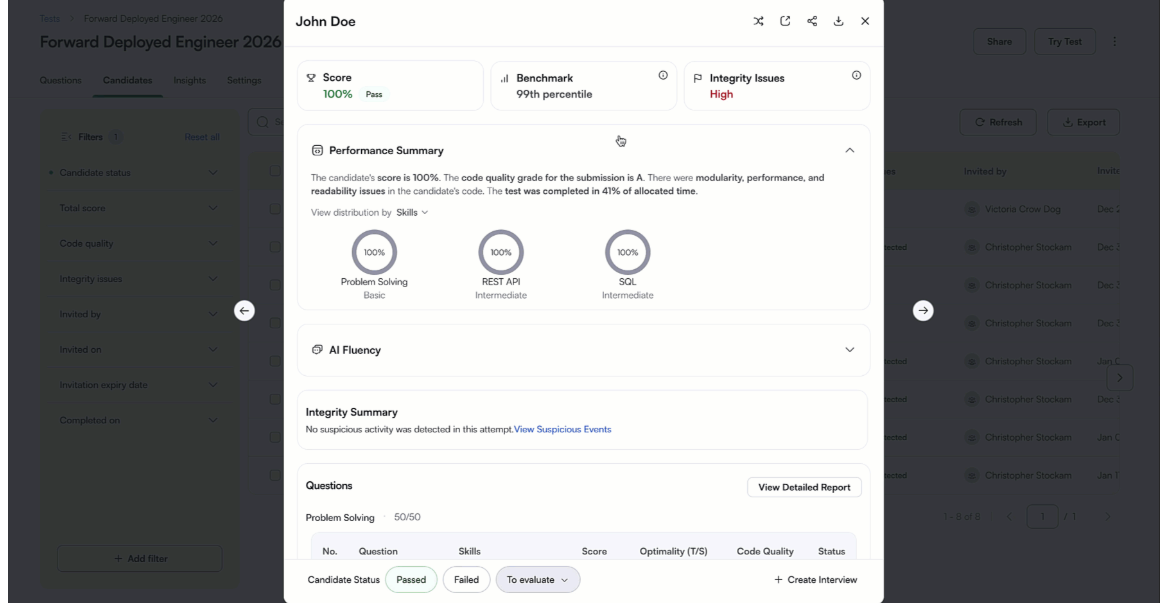
Alongside traditional coding proficiency, it tests how candidates work with AI during tasks. For example, guarded AI assistants can offer real-time syntax tips and debugging hints inside test environments.
HackerRank is made for engineering-heavy hiring at scale. Especially for teams that need to know how candidates collaborate with AI tools as part of job requirements.
It’s also just as handy for upskilling, with learning plans that help developers map current skills, earn certifications, and hit target proficiency levels.
Key features include:
- Advanced Evaluation scores how candidates use AI tools while coding
- Built-in AI Assistant (IDE and chat) lets candidates use guarded AI help mid-test, mirroring real developer workflows
- Automatic grading of code quality, problem-solving approach, and code review comments
- AI Plagiarism Detection, which flags AI-generated or copied code using HackerRank-only training data
- Auto-generation of skills-based assessments tailored to job descriptions
Not the best fit for: Companies focused on DevOps, site reliability, documentation, or security who won’t benefit from putting users through standardized code puzzles.
6. iMocha: Best for Evaluating Foundational to Advanced AI Literacy
iMocha is an AI-powered skills and work intelligence platform with an extensive library of assessments based on a candidate’s role and experience level.
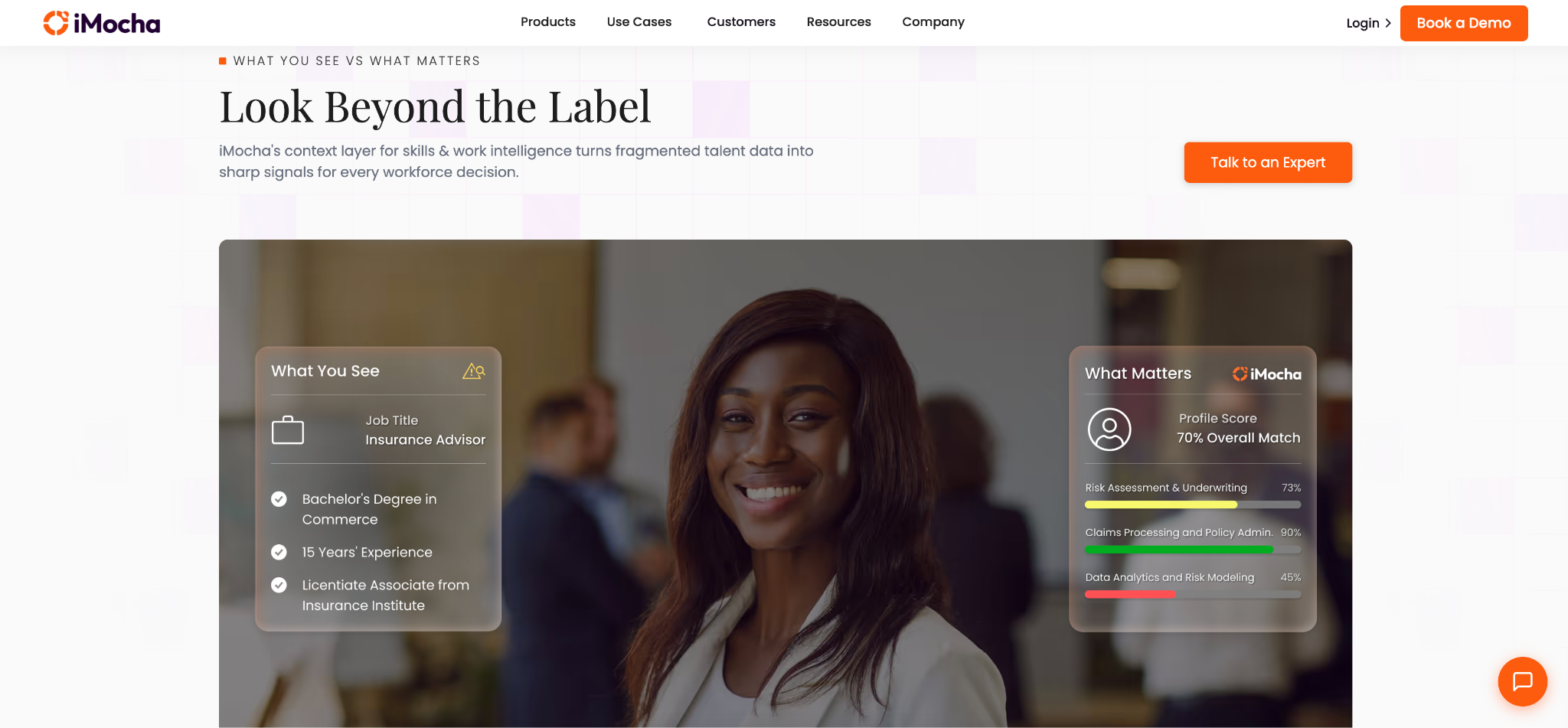
It suits HR and TA teams that want flexibility across a spectrum of AI skills, from testing baseline AI literacy in non-technical hires to deep learning expertise for specialist roles.
Companies can customize difficulty by picking easy, medium, or tricky questions. They can also combine multiple test types into a single assessment.
iMocha’s automated proctoring features also keep testing environments secure and help to prevent cheating.
Key features include:
- A library of over 10,000 skills tests
- Tests customizable by difficulty and tailored by role
- Multiple skill evaluations that can be combined into a single assessment
- Scenario-based questions that test practical application (e.g., live prompt engineering or model selection)
- A spectrum of AI/ML topics, from generative AI chatbot skills to advanced concepts like neural networks and bias mitigation
Not the best for: Fast-moving, high-volume hirers that want to avoid intense proctored exams.
How to Choose the Best AI Skills Assessment Tool
The best AI skills assessment tool for your company depends on your intended use case, company size, and industry. But there are more considerations that apply to every business.
Before locking into a vendor with a contract that’s painful to unwind, run the platform through this checklist:
- Independently audited for bias and accuracy. Third-party validation ensures a documented, legally defensible process (if anyone asks).
- Explainable, transparent scoring. Clear algorithms mean teams can confidently answer why a candidate scored a specific number.
- Human-in-the-loop built in. No AI-driven shortlist will be the final word when a person has the ability to review and overrule a score.
- Integration with ATS/HRIS. Choose a tool that talks to existing systems to reduce duplicate work.
- Tests role-specific skills vs. general AI literacy. Ensure you’re not paying for a tool that assesses the wrong skills entirely.
- Candidate-facing transparency about AI usage. Those who understand the process are more likely to trust it and engage with it fully.
Providers should be able to walk hiring teams through how the AI scores assessments and where humans are still critical.
That way, HR knows it has a compliant process that keeps candidates engaged and employer brands strong.
What Is an AI-Powered Skills Assessment?
AI-powered skills assessments are digital evaluations that use AI to analyze how candidates or employees perform real workplace tasks.
Instead of basing decisions on multiple-choice questions or resume screening, technology screens every applicant consistently at scale. Then, high-volume hiring teams review and corroborate the results.
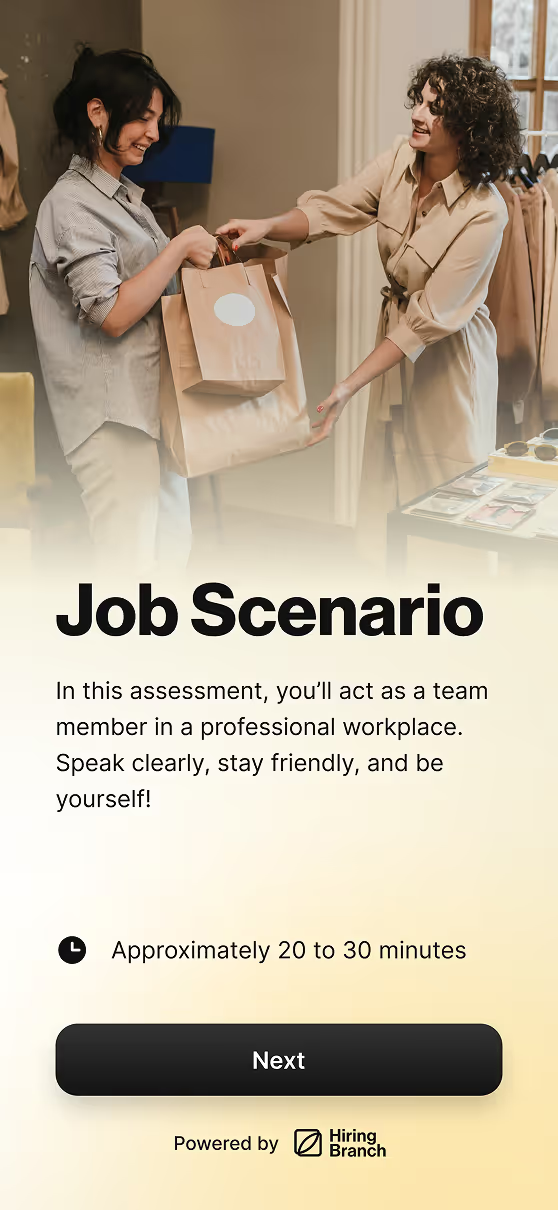
Because the tasks mirror the job itself, results predict performance far more reliably than a resume or generic personality quiz ever could.
Some of the components that make this work include:
- Open-ended conversational assessments that let candidates respond in their own words
- Voice and written scenarios that mirror specific role pressures, like ambiguous policy calls or refund requests
- Human judgment layered on AI shortlists to narrow the pool while letting a person make the final call
- Recruiter dashboards for metric tracking, so trends and gaps are visible at a glance
Structured, AI-scored evaluations can even speed up hiring time by roughly 80% and reduce bad hire rates to less than 1%.
How AI Skills Assessments Work: A Hiring and Upskilling Walkthrough
Picture a mid-size telecom company that’s hiring customer service agents year-round. It has sharp seasonal spikes around the holidays and an existing workforce that needs regular upskilling to keep pace.
Here’s how AI talent assessments could help with both.
Hiring Example
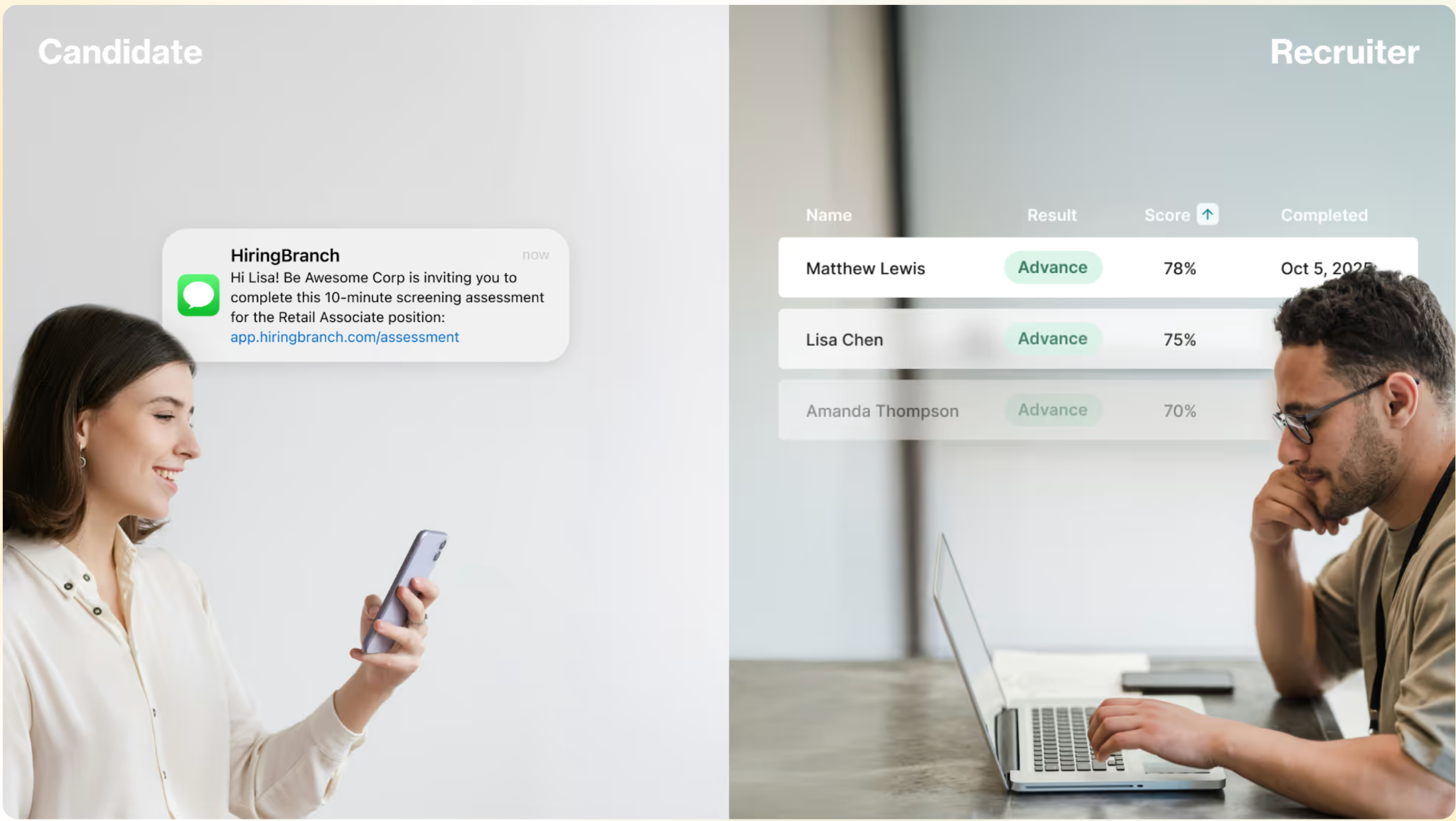
A candidate applies for an agent role and gets an automated SMS with a link to a short conversational assessment. The scenario is a real situation they’d face on the job: a potential buyer questioning how to book an appointment.
The candidate responds in their own words, by voice or text, just as they would in real life.
On the other side, recruiters see a dashboard that scores the response against the role-critical skills they’ve chosen. AI creates a top shortlist, while humans make the final call by reviewing text and recordings.
Upskilling Example
Months later, the telecom company applies the same assessment construct to existing agents to identify potential skills gaps.
For example, an agent might be technically accurate on policy but need to be more empathetic during escalations. Another might handle scripted calls fine but lose composure in more ambiguous situations.
Instead of blanket retraining, managers can target upskilling for specific soft skills and easily track improvement over time.
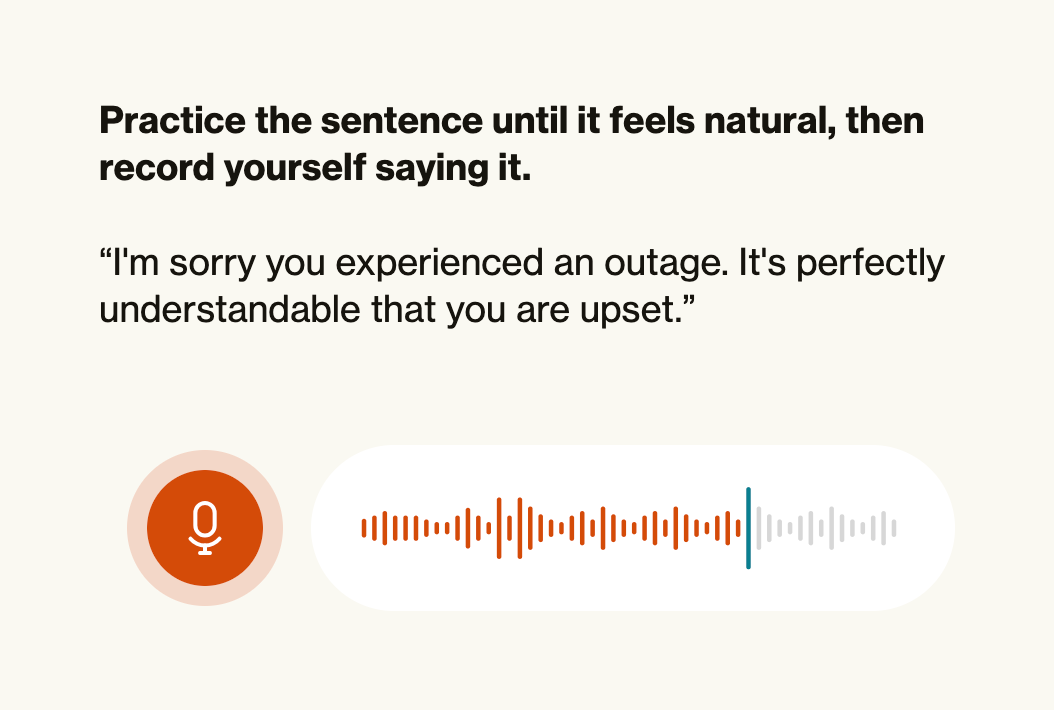
These assessments don’t measure AI skills. In this case, AI delivers the scenario and standardizes the scoring at a volume no human panel could match.
Wrapping Up the Best AI Skills Assessment Tools
There’s no single “best” AI skills assessment platform, as it’s completely dependent on what you’re trying to measure.
For role-critical skills, the sharpest results come from assessments that score how people interact in real workplace scenarios.
Always start with the required skill over a big-name vendor or extensive list of features. Once that’s clear, the right tool becomes much easier to find.
Image Credits
Feature Image: Via Pexels / Vitaly Gariev
Image 1: Property of HiringBranch. Not to be reproduced without permission.
Image 2: Via TestGorilla
Image 3: Via Vervoe
Image 4: Via CodeSignal
Image 5: Via HackerRank
Image 6: Via iMocha
Images 7–9: Property of HiringBranch. Not to be reproduced without permission.
AI Skills Assessments FAQs
Some do. But many tools use AI to standardize processes and assess broader hard and soft skills, such as communication, judgment, and problem-solving.
Yes. Most teams use AI to narrow the talent pool and speed up high-volume hiring timelines. Then, still manually review shortlisted or borderline candidates.
The right tools do. Say candidates complete the same scenario-based assessment asynchronously. Recruiters spend far less time reviewing pre-vetted shortlists and scenario transcripts, reduce the need for interviews, and see attrition drops that save on re-hiring.
Reactions vary. But being transparent upfront about how and why the process uses AI (i.e., to level the playing field and let everyone show what they can do) tends to improve candidate trust.
From free subscription tiers to custom enterprise contracts, pricing varies widely by vendor, test volume, and features.
Request a quote based on specific requirements and hiring volume rather than assuming a flat rate.
Effective as of July 2023, this New York City law applies to employers who use automated hiring tools.
Companies must commission annual independent bias updates, publish the results, and give candidates ten business days’ notice before using any tool.