



Human judgment is rife with unconscious predispositions. Learn how to reduce bias in hiring processes using independently audited AI tools.
Subscribe to our Newsletter
Like what you're reading? Leave us your email, and we'll deliver to your inbox on the last Thursday of the month.
US companies spend billions on DEI competencies to learn how to reduce bias in hiring processes. But Northwestern University found that candidates of color must still submit an average of 50% more applications per callback than their white counterparts.
Meanwhile, high-profile lawsuits against companies using AI recruiting tools have put the entire category under scrutiny. And employers are now liable for discriminatory outcomes, whether a human or an algorithm produced them.
These findings aren’t meant to deter you from using AI. In fact, independently audited screening tools are one of the most powerful ways to improve equality across diverse talent pools.
In this post, you’ll learn what the research says about hiring bias and how to evaluate any AI-powered platform before you trust it with your pipeline.
AI Bias in Hiring Is Real, But It’s Not the Whole Story
AI bias in hiring occurs when a machine learning model replicates or amplifies patterns of discrimination from its training data.
It’s a real, well-documented problem, leading 28% of US job seekers to fear AI bias will overlook their applications.
But the conversation has breezed over a key point: human hiring bias is far more widespread and almost entirely unaudited.
The “AI bias” headlines are familiar. Amazon scrapped its AI recruiting initiative in 2017 after internal audits revealed it was downgrading CVs that included the word “women’s” (thanks to a decade of training on male-dominated resumes and job descriptions).
More recently, a class action lawsuit was filed against Workday, alleging its AI screening tools discriminated against applicants by race, age, and disability.
Another filed in January 2026 alleges that Eightfold AI’s hiring platform violates the Fair Credit Reporting Act (FCRA).
AI-powered “Match Scores” rank candidates from 0–5 and automatically filter out the lowest-ranked candidates before humans review them.

In response, the Equal Employment Opportunity Commission (EEOC) clarified that employers remain liable for discriminatory practices. Regardless of whether a human or an algorithm made the call.
Founder of the Future of Talent Institute and one of the most widely-read voices in talent acquisition, Kevin Wheeler, saw AI’s potential years ago:
“I think that the whole assessment process needs to be built on data. How do you determine performance, and how do you verify the qualities or traits that led to that performance? If you really have that nailed down in a valid, verified way, then the technologies can be very effective in finding people that match those same traits and characteristics.
The challenge there, of course, is how do we make sure we’re just not hiring clones? You have to allow some fuzziness around those things in order to bring that diversity in.”
The question recruiters at high-volume organizations need to answer in 2026 is: “Is a well-configured, independently audited AI screening tool more biased than the unstructured human judgment it’s replacing?”
What Does Human Bias in Hiring Actually Look Like?
From callback rate disparities to fatigue bias, human judgment is one of the biggest barriers to inclusive hiring. And it goes almost entirely unaudited.
In one of the most replicated studies of labor economics, researchers sent identical CVs to over 1,300 job ads in Boston and Chicago. Only the name at the top varied.
Resumes with white-sounding names received 50% more interview callbacks. The racial gap persisted across occupations, industries, and employer sizes.
The candidate selection process can even be troubling when humans and AI work together. A 2025 University of Washington study asked participants to screen applicants for 16 different jobs using simulated AI recommendations.
When selecting without (or with a neutral) AI, participants chose white and non-white applicants at equal rates. But when the AI showed racial bias, participants followed its lead of favouring white or non-white candidates.
The most typical types of bias in hiring practices include:
- Affinity bias. Favouring candidates who share a background, university, or communication style as the recruiter.
- Halo effect. Letting one strong signal (e.g., an impressive employer or confident handshake) inflate the overall impression.
- Confirmation bias. Seeking information that validates a first impression rather than challenging it.
- Perception bias. Applying different standards to the same behaviour depending on a candidate’s gender, race, or age.
- Fatigue bias. Making systematically different decisions at the end of a long review session than at the start.
- Anchor bias. Being disproportionately influenced by the first candidate and unconsciously measuring the rest against them.
These unconscious biases (or implicit biases) are largely invisible and self-reinforcing. As Assaf Bar-Moshe, PhD, Chief Research and Development Officer at HiringBranch, notes:
“As much as they would like to, humans cannot entirely isolate their prejudices. This is more pronounced if the team has a large volume of assessments, which would not be evaluated by a single person. No matter how you try to standardize the ‘rubric’ or the evaluation process, there will be bias when it’s done by humans.”
Examples of Human Bias in High-Volume Recruitment
High-volume human screening includes three compounding failure models (fatigue bias, affinity bias, and panel inconsistency).
Here’s how each of these models intertwine during recruitment processes:
- Fatigue bias. A recruiter reviewing their 300th application of the week won’t make the same quality of hiring decision as they did for the first 30. Energy drops, pattern-matching gets lazier, and candidates at the bottom of the pile pay the price.
- Affinity bias. Reviewers drift toward candidates who feel familiar, attended similar schools, or communicate in a mirroring style. While not malicious, this “cultural fit” label can shape a lack of diversity at scale.
- Panel inconsistency. When more than one person screens, hiring teams immediately introduce different perspectives, multiple personal biases, and oversights that impact consistency.
These patterns don’t make the news because they don’t have a product name attached.
How Audited AI Screens Candidates More Fairly Than a Human
A well-configured AI screener always applies the same weighted criteria in high-volume hiring and removes the variables that human judgment can’t.
So, it’s one of the most practical tools available for building an inclusive workplace. These platforms don’t find one candidate’s communication style more relatable and can’t compare notes with a colleague.
For example, Job Skills Screen doesn’t collect any data about gender, race, sexual orientation, or native language. Instead of reading resumes, it assesses job performance in real-world scenarios.

Companies using technology like this for high-volume recruitment cut time-to-hire, see huge gains in retention, and lower attrition.
Assaf Bar-Moshe explains how the AI screener featured above contributes to naturally diverse workforces:
“[HiringBranch] AI is blind to accents, the color of the person, the gender of the person, their age, and other features. As data scientists, we do not introduce these features into the machine, so the machine does not use them for classification.
We don’t look at a group of women and men separately. We don't measure native speakers and non-native speakers separately. The machine makes decisions without knowing if somebody’s a man, is white, or anything like that.”
Any AI screening tool can claim to be objective. However, independent testing for potential biases avoids legal consequences.
A third party (with no stake in the result) must analyze automated outputs across diverse candidates, considering:
- Race
- Gender
- Different backgrounds and socio-economic statuses
- Sexual orientation
- Other protected characteristics like disabilities, pregnancy, or religion
For example, HiringBranch recently passed an independent bias audit from BABL AI Inc. under New York City’s Local Law 144. One of the most rigorous AI hiring bias standards currently in force in the US.
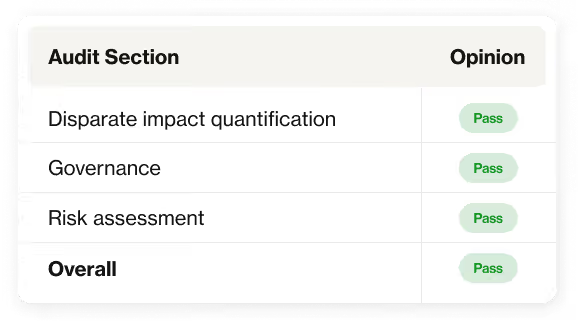
It’s important to note that most hiring managers don’t have their instincts tested across demographic groups like this. Their year-on-year decisions or callback patterns are never reviewed by a third party or published.
We hold AI to a standard we’ve never applied to the humans it’s replacing. In doing so, we’ve let the baseline off the hook entirely.
5 Questions Hiring Teams Should Ask When Evaluating AI Screening Tools
The regulatory ground under AI-powered hiring tools is shifting fast. Several US states have active bills in progress, and the EU AI Act classifies these platforms as high-risk, with their own compliance requirements.
When evaluating any vendor, get the answers to these five questions before signing anything.
1. Has the tool had its yearly independent third-party bias audit?
Look for a named third-party firm, a documented methodology, and results tested against real candidate data.
A vendor who can’t produce this isn’t necessarily hiding something, but they are asking you to take their word for it. An audit conducted by the vendor’s own team is a self-assessment.
Companies should also be continually monitoring AI tools to ensure they’re fairly assessing top talent.
2. Is the audit report publicly available or available on request?
Passing an audit and publishing the results are two different things. Transparency here is a signal of confidence.
If a vendor hesitates to share the report, ask why. “It’s proprietary” is not an acceptable answer for something that directly affects your legal exposure.
Note: Hiring teams can request a copy of BABL AI’s audit report through HiringBranch’s trust center.
3. Can the vendor confirm which protected characteristics were tested?
Bias audits vary significantly in scope. A rigorous audit will test for disparate impact across race, ethnicity, gender, age, and disability status at a minimum.
If a vendor’s audit is vague or only covers one or two characteristics, it may be technically compliant without meaningfully protecting diverse hiring. Ask for the specific demographic categories tested and any adverse impact ratios.
For example, this closely aligned impact ratio in BABL AI’s audit indicates no gender bias in HiringBranch:
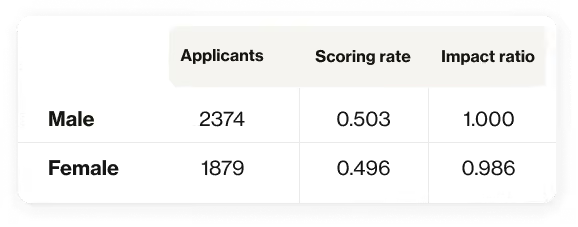
Impact ratios exceeded the 0.8 threshold for all demographics, indicating no adverse impact on diverse teams.
4. Is there a human review step before any adverse action?
NYC LL144 requires companies to inform applicants that they’re using AI in recruitment or interview processes. But no automated system should be the final word on a candidate’s progression without human review.
Ask where the human checkpoints are, who is responsible for them, and what happens if a candidate disputes an outcome.
5. Does the tool comply with NYC Local Law 144 and equivalent emerging laws?
As mentioned, LL144 is the most specific standard currently in force. But it won’t be the last. Ask your vendor how they monitor and respond to emerging legislation.
A company with no answer to that question could be one audit cycle away from becoming a liability.
Some Red Flags to Consider
Some vendor responses should prompt immediate follow-up questions regardless of how polished the sales deck is:
- “Our tool is bias-free.” No tool is completely free from bias. Any vendor making this claim either hasn’t looked hard enough or isn’t being straight with you. The honest claim is “audited for bias with published results.”
- “We conducted our own internal audit.” Internal audits don’t meet LL144 requirements or provide the independent verification you need. Push for third-party.
- “We use AI, but it’s just a scoring assist.” If an algorithm is influencing which candidates a human sees, it’s considered an automated employment decision tool (AEDT) under LL144. The label doesn’t change the legal implications.
- “Our training data is proprietary.” A vendor should still be able to tell you the demographic composition and how they’ve tested for proxy discrimination.
This is why Assaf Bar-Moshe champions research before any AI adoption:
“If you’re thinking about adopting AI in your hiring pipeline, just be cautious. Do your research and verify that what the service provider sells works, as proven by data and analysis. And when it does, just embrace it. It will save so much time and effort while giving you unbiased results and more qualified candidates.”
The sales process is the easiest moment to ask hard questions. A vendor that is serious about inclusivity will already anticipate them and welcome the scrutiny.
Wrapping Up Bias in Hiring
To meaningfully reduce bias in hiring, build a process that makes your own biases visible and improvable over time. That means using set evaluation criteria, independent validation, and human oversight at crucial moments.
Diverse teams consistently outperform in problem-solving and decision-making. The question is whether your screening process is building them or filtering them out.
Audit your AI tools. Scrutinize your unstructured interviews. Track the metrics that tell you whether each is working, and hold both to the same standard.
Image Credits
Feature Image: Via Pexels / cottonbro studio
Image 1: Via G2
Image 2: Property of HiringBranch. Not to be reproduced without permission.
Image 3: Property of HiringBranch. Not to be reproduced without permission.
Image 4: Property of HiringBranch. Not to be reproduced without permission.
Understanding AI Bias FAQs
Using a biased AI hiring tool can create legal exposure under Title VII of the Civil Rights Act and EEOC guidance on disparate impact. The law doesn’t prohibit AI in hiring. However, it holds employers liable for any discriminatory outcomes and inequitable work environments.
NYC Local Law 144 goes further. It requires annual independent bias audits for any AEDT used to screen candidates for NYC-based roles.
No. AI models and hiring committees can infer protected characteristics through proxies like college attended, zip code, employment gaps, or language patterns. Even without a name attached. Meaningfully reducing bias requires auditing the full scoring pipeline.
Independent analysis tests whether an AI hiring tool produces different outcomes across demographics for equally qualified candidates. This applies to tools that screen documents or people, ask structured interview questions, or score applicants or resumes.
A rigorous audit examines adverse impact ratios across race, ethnicity, gender, and other protected characteristics. It’s also conducted by a neutral third party.
NYC Local Law 144 sets the minimum bar at annually. However, AI models can drift as companies retrain them on new data. Any significant update to the model or its bias training data should trigger a fresh review.
Ask for the audit report directly. A legitimate audit is conducted by a named independent third party. It should test for disparate impact across multiple protected characteristics and produce a shareable summary of results.
NYC Local Law 144 applies to any employer or employment agency using an AEDT to screen candidates for NYC-based roles. Companies must conduct an annual independent bias audit, publish the results, and notify candidates before using the tool.


.avif)


.svg)