



Resume parsing software is unreliable. Learn how skills-based screening helps you predict candidate performance in the earliest hiring stages.
Subscribe to our Newsletter
Like what you're reading? Leave us your email, and we'll deliver to your inbox on the last Thursday of the month.
When hundreds or thousands of applications hit your ATS, automation is essential to take the pressure off. But resume parsing software was never built to identify talent; it only sorts text.
When studies show that parsing algorithms are typically only 60–70% accurate, that means a significant portion of documents are misread or improperly ranked before a human ever reviews them.
In this post, you’ll learn how resume parsing works, why it’s unfit for purpose, and a better way to assess job-relevant performance without slowing down the funnel.
What Is Resume Parsing Software?
Resume parsing software automatically extracts information from resumes and converts it into structured data, usually within an applicant tracking system (ATS).
When a candidate uploads a PDF or Word document, a resume parser scans it and pulls out details like name and contact information, work experience and job titles, employment dates, education, skills and certifications.
Here’s what this data extraction process looks like behind the scenes:
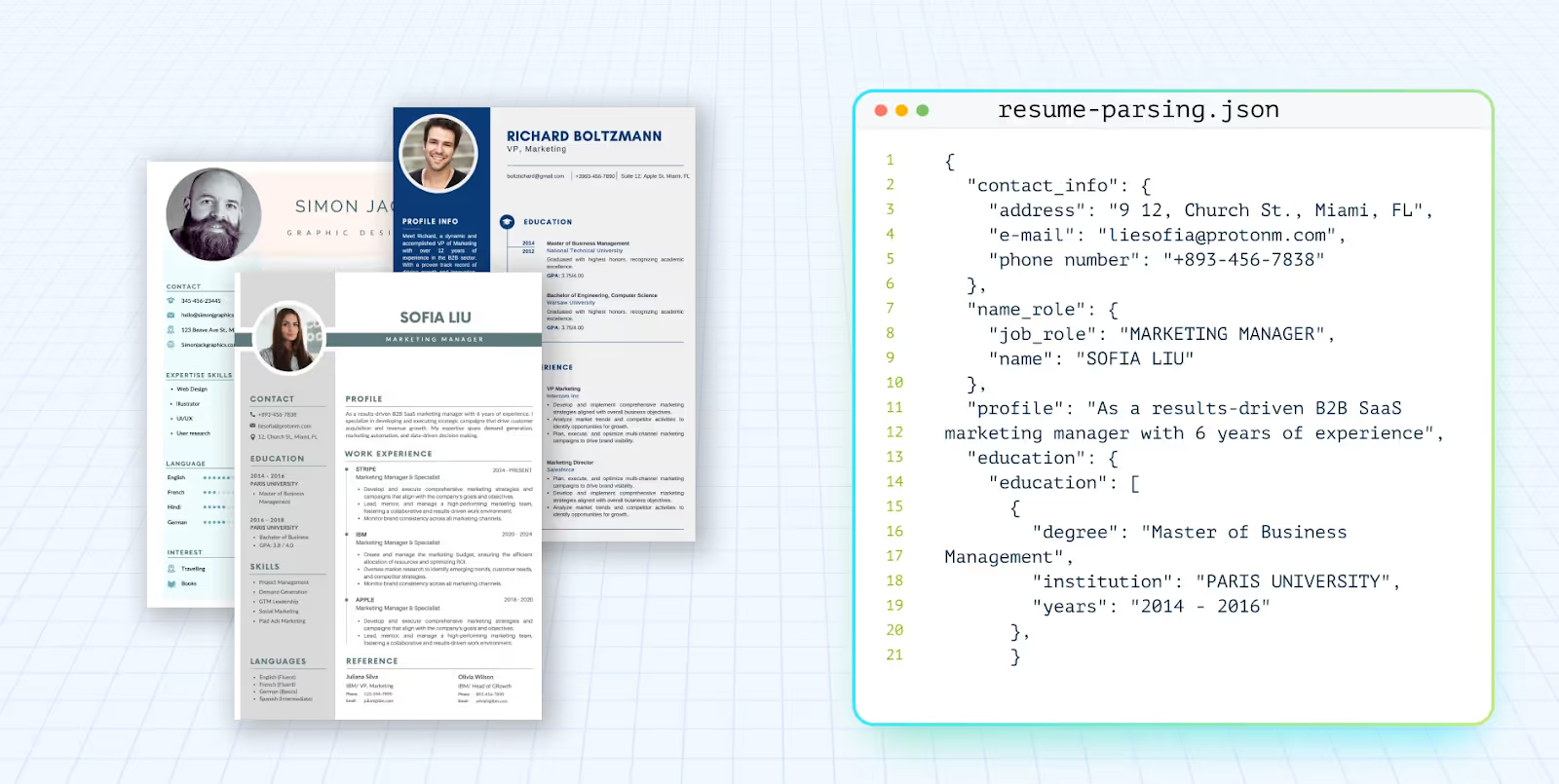
Instead of manual data entry (which increases the likelihood of human error), the system automates and organizes it into searchable fields.
Resume parsing software initially became popular because it helped teams save time reviewing thousands of resumes in competitive job markets. Standardizing messy, inconsistent resume formats also makes filtering and reporting easier.
For recruiters hiring at scale, this technology has always aimed to streamline the administrative side of screening and fill positions faster.
How Does Resume Parsing Software Work?
Resume parsing software converts candidate information and job data into structured, searchable formats. Instead of reading every single resume, recruiters and HR teams review filtered lists based on keyword matches or automated scoring systems.
Here’s how most recruitment software parses resumes in six steps:
- A candidate uploads a resume (PDF, docx, HTML, etc.) or the system collects it from sourcing websites like job boards, emails, and social media platforms
- An API scans the document and extracts key fields like name, experience, education, and skills
- That information is standardized using taxonomy labels (e.g., mapping job titles like “Software Engineer” to “Developer”)
- The doc then becomes an XML or JSON format inside the ATS
- The system matches or scores resume data against the job description
- Recruiters review the parsed data or rely on ATS rankings to decide who moves forward
Functionalities and workflows differ across tools. For instance, some offer additional multilingual support or enrichment features that supplement resumes with real-time LinkedIn data.
But one thing all parsing solutions have in common is that they rely solely on the information within CVs.
Key Methods Used by Resume Parsing Tools
Resume parsing software turns unstructured text into structured data by scanning for keywords, applying language rules, using artificial intelligence (AI) to spot patterns, or a mix of all three.
Here are the key methods these tools use:
- Keyword-based parsing. The system searches for exact words or phrases from the job description. If the right word isn’t present, the candidate is overlooked.
- Grammar-based parsing. Predefined rules help parsers understand sentence structure and context. While more advanced than keyword matching, it’s still limited by how well algorithms anticipate and accommodate variation.
- Statistical or AI-driven models. By identifying patterns across large datasets, AI-powered resume parsing predicts how closely someone’s background matches the role. Accuracy improves with more data, but it can be unclear why one candidate ranks higher than another.
- Hybrid models. These parsers combine keywords, grammar rules, machine learning, and deep learning capabilities to improve reliability and speed.
While some companies rely on seamless integrations with ATS or CRM platforms, others build in-house proprietary parsing engines as part of their hiring stack. Yes, they process information quickly and efficiently. But unlike other types of screening software, they don’t identify whether someone will actually be able to do the job.
5 Problems With Resume Parsing Software for High-Volume Recruiters
CV parsing filters out strong candidates who describe experience differently and rewards wording that matches job postings over performance.
Meanwhile, many resumes are now AI-generated or keyword-optimized specifically to pass filters. Recruiters end up paying for software that reads inflated or strategically engineered content.
Here’s how parsers miss top candidates, reward the wrong behavior, and can reinforce biases.
1. Missing Qualified Candidates
Parsing software struggles with resumes that don’t fit expected templates (e.g., unconventional formatting or different wording from job descriptions) and can overlook applicants with strong experience.
For example, there are hundreds of blog posts that teach candidates the apparent “right” and “wrong” ways to get past ATS scanners and parsers:
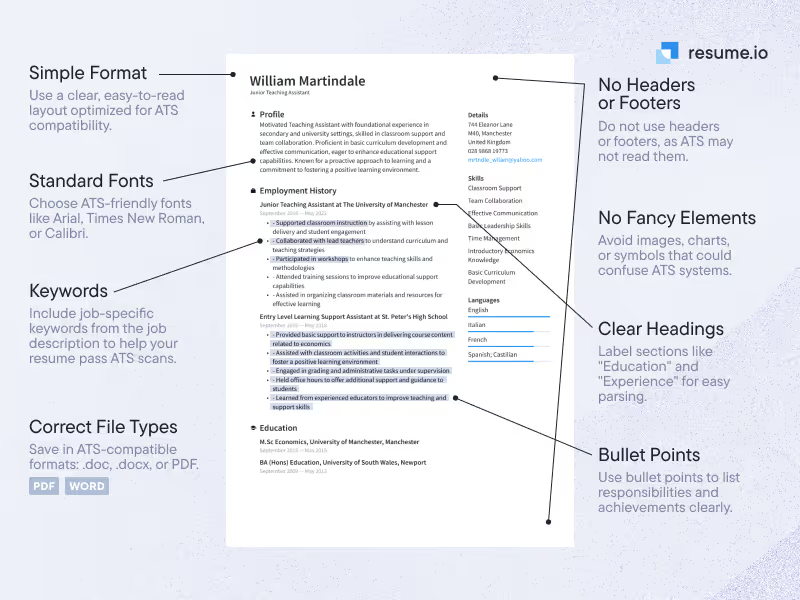
A marketing pro who adds an image to their CV or a different file type may get filtered out, even though their qualifications perfectly match the role.
One startup even experimented by rebuilding a single great resume into nine versions, using common word-processing platforms and resume builders. The most successful only had 58% of its data parsed properly.
2. Encouraging Keyword Stuffing
As many parsers score using keywords, applicants optimize for how the software works (rather than demonstrating skills) to pass early hiring processes.
It’s no wonder Reddit forums are full of candidate discussions of how to “beat” the system:
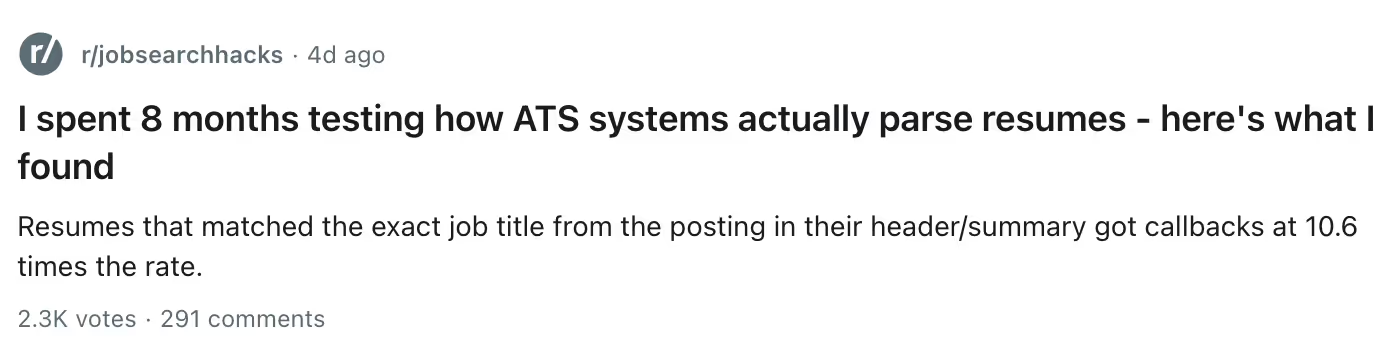
When applicants focus on keywords, recruiters end up with a shortlist that looks strong on paper (often stuffed with buzzwords) but doesn’t necessarily reflect true capability.
3. Ignoring Soft Skills and On-the-Job Performance
CV parsers can only read text, so they don’t assess personality or soft skills (e.g., communication, adaptability, or problem-solving) that are critical for most roles. One study found that recruitment systems reject almost 50% of applicants without evaluating these crucial elements. And 23% of these rejections are down to parsing errors specifically.
Someone with little experience may perform naturally well in on-the-job scenarios. However, recruiters who rely on resume parsing will never give them a chance to prove it.
4. Can Reinforce Bias
Algorithms are trained on historical employee and candidate data that can favor certain schools, companies, or demographics (even unintentionally).
For example, Amazon’s screening and parsing tool infamously penalized resumes that included the word “women’s” (e.g., “women’s volleyball captain”) as it was trained on 10 years of male-dominated applications.
For high-volume hirers, these built-in biases amplify systemic inequities and reduce diverse candidate pools.
5. Many Resumes Are Now AI-Generated
Recruiters who use resume parsing software are likely spending money on analyzing false data, as many CVs are now AI-generated.
According to Gartner research, almost 40% of candidates admit to using AI to help write CVs and answer application questions. In fact, the same study predicts that one in four global candidate profiles will be completely fake by 2028.
But AI isn’t inherently the problem. When used properly, this technology can still save time while assessing skills and language comprehension. Candidate experience improves, and teams know those who advance early in the funnel are genuinely capable of performing the role.
How to Replace Inefficient Resume Parsing With Skills-Based Screening
While resume parsing software sorts candidates by what they say they can do, skills-based screening evaluates what they can actually demonstrate. Assessing candidates with short, job-relevant tasks at the very start of the funnel keeps the process fast but makes it far more predictive of role success.
For example, Job Skills Screen gives applicants written instructions about fictional customer scenarios:
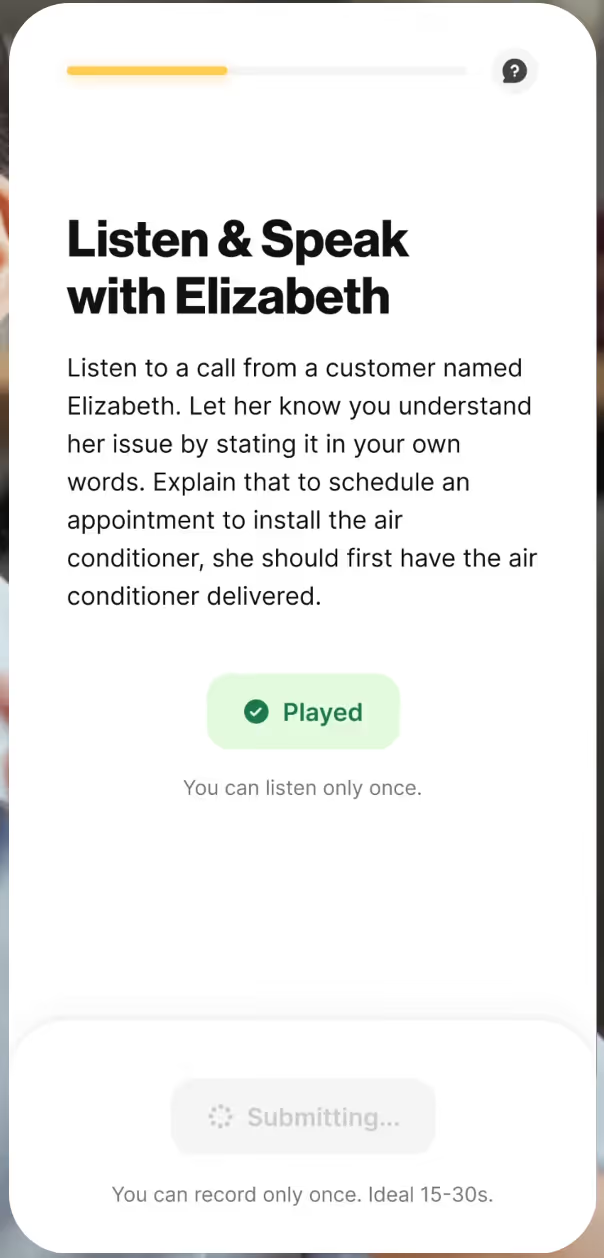
Candidates use written or spoken responses to complete five tasks. Then, the system uses AI to score them based on their soft skills and language comprehension. As it’s all automated, recruiting teams simply review rankings and responses to experience how applicants would really interact on the job.
With the software analyzing language fluency, decision-making, and job-relevant outputs, top talent naturally unearths itself. And candidates who move forward have already shown they can handle the core requirements of the role.
Here’s how skills-based screening directly addresses the weaknesses of resume parsing:
- Forget resume formatting or phrasing. Candidates who can perform the task move forward, regardless of how they wrote their resume.
- Applicants can’t game real assessments. Demonstrated ability in the specific role (e.g., sales or customer support) replaces keyword optimization.
- Technology doesn’t rely on text matching. Modern screening tools use AI to evaluate communication clarity, reasoning, comprehension, and behavioral signals.
- Background doesn’t matter. Performance-based evaluation reduces reliance on pedigree, school names, or past employers.
Our recent research even suggests that skills-based hiring reduces bad hiring rates by 400% for large companies, translating into millions saved in turnover and productivity loss. In one real-world example, business outsourcing provider JustPressOne found that candidates with higher skills-based assessment scores consistently achieved better QA ratings on the job.
Wrapping Up Resume Parsing Software
Resume parsing software that filters by exact wording and rewards formatting over real capability isn’t going to help determine the best-performing candidates.
Speed and scalability will always be crucial for high-volume talent acquisition. But skills-based screening means you don’t trade speed for quality hires.
Image Credits
Feature Image: Via Pexels / Nemuel Sereti
Image 1: Via Unstract
Image 2: Via Resume.io
Image 3: Via Reddit
Image 4: Property of HiringBranch. Not to be reproduced without permission.
Resume Parsing Software FAQs
Resume parsing software (like Textkernel or RChilli) improves efficiency by organizing and filtering large volumes of applications. However, it can’t measure real on-the-job performance.
No. Parsing software simply analyzes text. It can’t reliably assess communication skills, adaptability, problem-solving, or cultural fit. Those traits require behavioral data, structured assessments, or real task-based evaluation with tools like HiringBranch.
AI excels in sorting structured data at scale, far faster than humans. However, it’s limited to the information provided. If job seekers provide incomplete, keyword-optimized, or AI-generated documents, the output reflects that.
High-performing volume hirers use AI to evaluate real-time performance, communication, and comprehension (rather than to extract data and match text).
Skills-based screening tools replace resume filtering altogether. Instead of ranking candidates by keywords, they assess real ability early in the recruitment process through short job-relevant tasks or structured evaluations.
This process unearths the best candidates based on what they can do, rather than what they say.
.avif)
.avif)




.svg)