



Compare 6 candidate assessment software tools for high-volume, customer-facing hiring, and learn how to choose the right one for your team.
Subscribe to our Newsletter
Like what you're reading? Leave us your email, and we'll deliver to your inbox on the last Thursday of the month.
In high-volume hiring, candidate assessment software helps teams move faster without weakening hire quality.
For customer-facing roles, that means seeing how candidates communicate, solve problems, and respond under pressure before the interview. Stronger screening gives hiring teams a clearer early signal of how candidates may perform on the job.
In this article, you’ll compare six candidate assessment software tools for high-volume, customer-facing hiring, see where each fits, and learn what to prioritize when choosing one.
Key Takeaways From Candidate Assessment Software
- Using candidate assessments earlier in the hiring process gives teams more structured evidence for deciding who should progress to an interview.
- The strongest platforms help high-volume teams make faster decisions without sacrificing hire quality, especially where communication and judgment affect customer outcomes.
- Different tools measure different signals, from technical and cognitive skills to structured responses and real-world task performance, so the right fit depends on the roles being filled.
- HiringBranch is built for high-volume, frontline, and managerial hiring, using scenario-based assessments to measure demonstrated interpersonal, cognitive and language skills before the interview. Explore HiringBranch to see how it can fit into your recruitment process.
What Is Candidate Assessment Software?
Candidate assessment software evaluates a candidate’s job-relevant skills directly, giving hiring teams structured evidence of how well they might perform.
The category spans several formats, including skills-based hiring assessments, cognitive and personality evaluations, video interviews, and work-simulation tasks. What they share is a more structured way to assess candidates' capabilities before a hiring decision is made.
That makes it different from resume screening, which ranks applications by what candidates say about themselves.
Because those formats serve very different hiring needs, candidate assessment software is often treated as a role-agnostic category, even though the most useful assessment depends heavily on the work itself.
For frontline roles, that means looking beyond whether a platform assesses candidates at all and examining which skills it can surface and how closely those skills reflect real job performance.
What Can Candidate Assessment Software Evaluate?
Candidate assessment software can measure soft skills or hard skills, but it all depends on what the role requires. The assessment should be able to evaluate the candidate in scenarios relevant to the job. A call center assessment test, for example, should tell you how candidates respond in realistic service situations. For frontline hiring, the most useful candidate assessment software can evaluate communication, problem-solving, and judgment under pressure, and that includes the following:
- Communication. How clearly a candidate explains information, adapts their tone, and handles misunderstandings during a realistic interaction.
- Problem-solving. How a candidate works through an unfamiliar or ambiguous situation instead of relying on a rehearsed response.
- Judgment under pressure. How a candidate responds as a scenario develops, including whether they stay composed and make decisions appropriate to the situation.
Different platforms measure these capabilities in different ways, drawing on a few established formats:
- Situational judgment tests. Present realistic scenarios to see how candidates handle decisions under pressure.
- Behavioral assessments. Look at how someone works, communicates, and responds to conflict.
- Cognitive ability tests. Measure reasoning, information processing, and cognitive aptitude for picking up new systems quickly.
- Personality assessments. Map personality traits such as patience, resilience, and adaptability against role demands.
- Technical skills and coding assessments. Verify hands-on ability for roles that require it, though it matters less in customer-facing hiring.
- Job simulation tools. Put candidates into the actual work, which is the closest proxy for job-specific skills.
For frontline roles with customers and patients, soft skills like communication, judgment, and emotional intelligence carry more predictive weight than technical ability. A platform that only offers cognitive assessments will miss most of what determines whether someone can actually do the job.
6 Best Candidate Assessment Tools for High-Volume Hiring
High-volume, customer-facing hiring calls for talent assessment tools that can consistently evaluate relevant skills at scale, like HiringBranch. Broad library platforms such as TestGorilla and iMocha are also common in this category. The six tools below were selected for their relevance to high-volume, customer-facing hiring.
Depending on the needs of the hiring team, each tool listed below is worth evaluating. They all differ in what they assess and how they fit into the recruiting process (and pricing! But you’ll have to reach out to the vendors for that).
- HiringBranch
An explainable AI skills assessment built for frontline, high-volume hiring that measures all skills with 98% accuracy in one short voice or chat conversation with the candidate.
Best for: Contact centers, retail, healthcare, banking and insurance, and other high-volume or frontline teams.
Key strength. Role-play scenario-based voice assessment and skills intelligence. - HireVue
An AI-driven video interviewing and assessment platform.
Best for: Enterprises that hire across multiple role types and programs.
Key strength: Video interviewing, assessment, and workflow automation in one platform. - Harver
A talent assessment platform built for high-volume hiring.
Best for: BPOs, contact centers, retail, and other large-volume employers.
Key strength: Broad assessment coverage combined with automation. - Vervoe
An AI-powered assessment platform that evaluates job performance through coding, video, and task-based exercises.
Best for: Teams that assess candidates across varied role types.
Key strength: Flexible task-based assessments with automated scoring. - Sapia.ai
A chat-based AI interview platform that scores candidates through chat.
Best for: High-volume teams that use competency-based screening before recruiter review.
Key strength: Structured chat-only interviews scored against role-specific competencies. - Willo
Screening and structured video interviews, responses, and assessments to surface qualified candidates at scale.
Best for: Teams that are replacing early phone screens at scale.
Key strength: Flexible asynchronous screening with verification and workflow integrations.
HiringBranch
HiringBranch is a conversational role play assessment and skills intelligence platform built for frontline, high-volume hiring. Its assessments place candidates into open-ended voice, chat, and email scenarios modelled on real customer interactions.
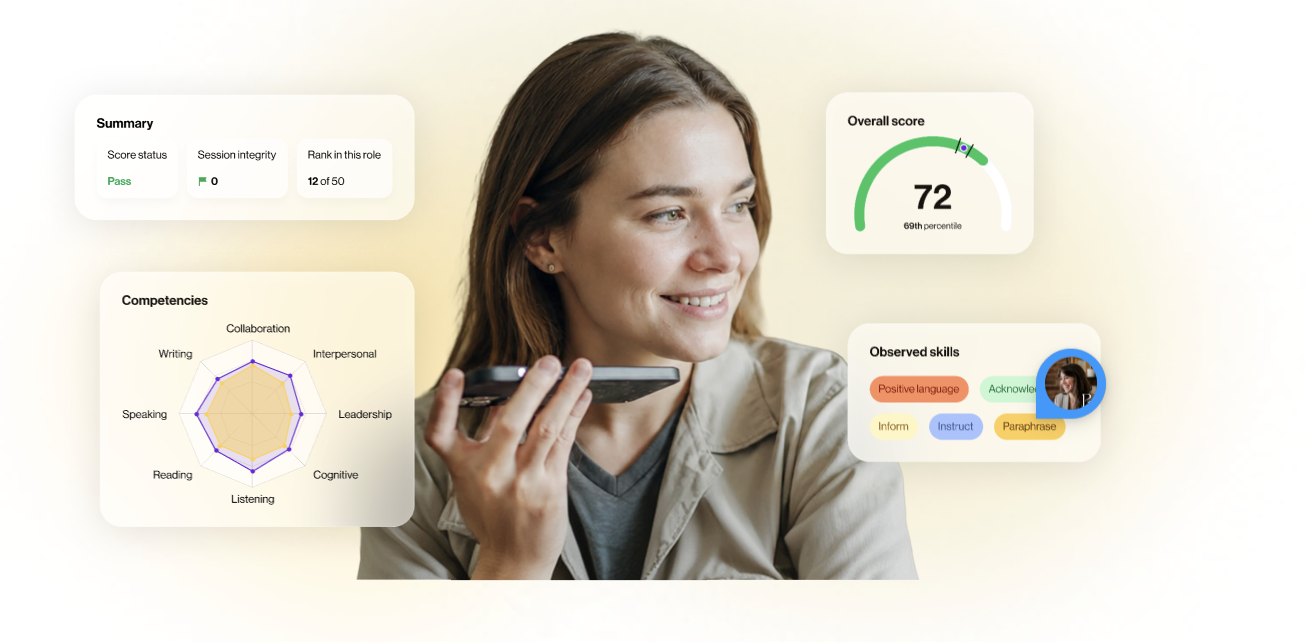
HiringBranch’s proprietary AI evaluates skills such as communication, critical thinking, fluency, and other job-relevant capabilities, giving talent acquisition teams evidence of job performance even before the interview.
“Applicants described HiringBranch as ‘the most human-like assessment experience’ they had encountered at the top of the funnel.”
This experience translates well for candidates, too. One verified user on G2 said applicants described HiringBranch as “the most human-like assessment experience” they had encountered at the top of the funnel.
What HiringBranch Does Well
- Measures demonstrated skills in realistic scenarios. Candidates respond freely to job-specific situations instead of choosing predetermined answers.
- Supports high-volume screening earlier in the funnel. Its Job Skills Screen uses five tasks and takes about 10 minutes for a candidate to complete.
- Fits existing hiring workflows. ATS integrations can trigger assessments and return candidate scores directly to the hiring system.
- Multiplies top talent. By benchmarking your top performers’ skills and retrofitting that into an assessment, HiringBranch supports the creation of skills taxonomies built on what works inside each organization.
- Talent mobility. HiringBranch proved that people (n=700) with sales skills can do customer service but not the other way around. People with customer service skills can’t necessarily do sales. This data was based on assessments that tell you which person is best suited for one role or another.
HireVue
HireVue is an AI-driven interviewing and assessment platform useful for high-volume hiring workflows.
The platform combines video interviewing, AI-supported assessments, scheduling, and workflow automation across hourly, professional, graduate, technical, and internal-mobility roles.
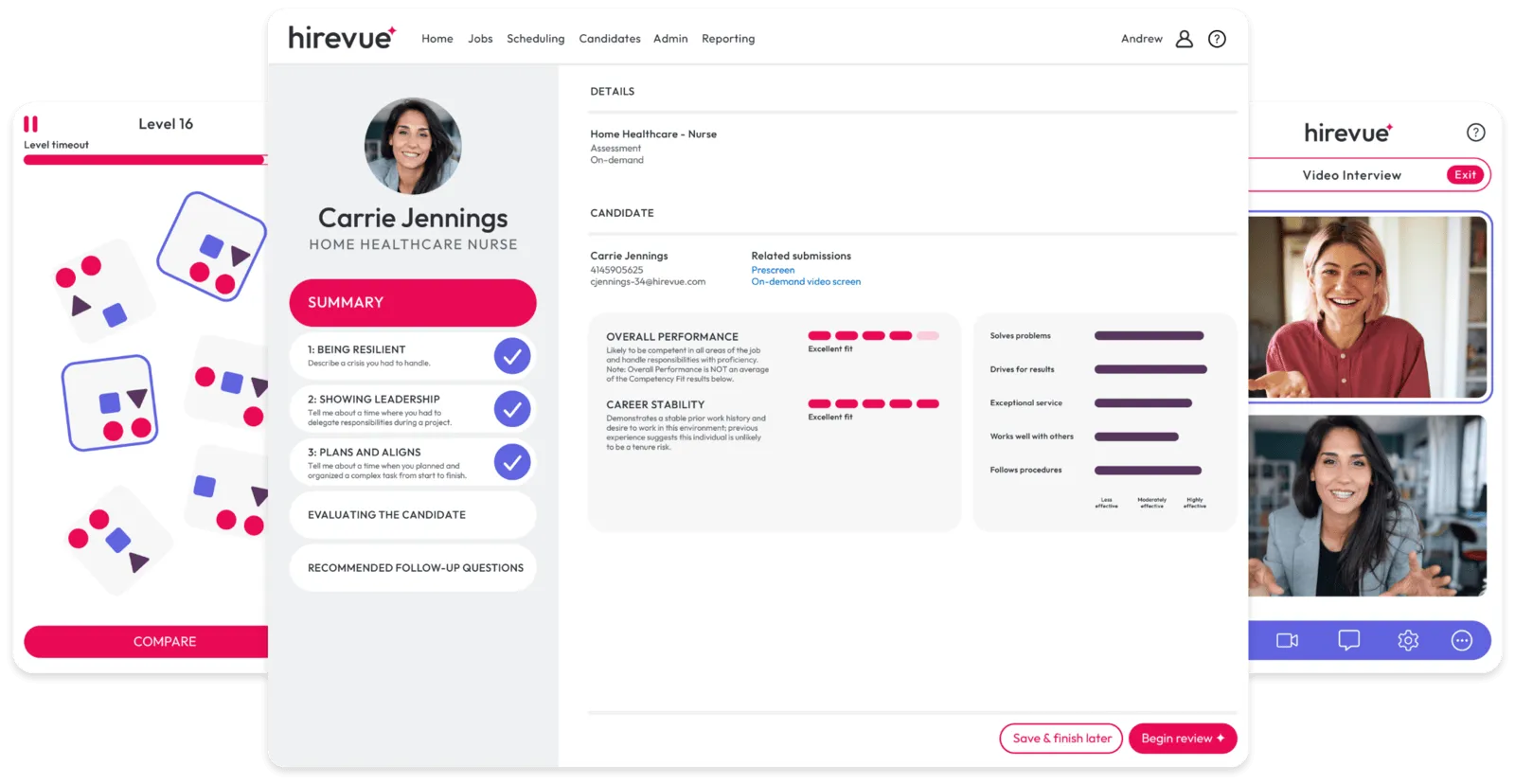
Its biggest advantage is breadth. HireVue can support structured interviews and role-specific skills validation within the same workflow, while integrations help larger teams move candidate data through existing ATS systems.
However, candidate reactions can be mixed. Some appreciate the flexibility of asynchronous interviews, while others find one-way formats less personal due to the lack of real-time interaction.
What HireVue Does Well
- Combines multiple formats. Teams can evaluate candidates through video interviews, job tryouts, and technical assessments in a 45-minute, multi-format assessment flow. Note that candidates can drop off after just minutes, especially for hourly roles.
- Supports enterprise-scale workflows. Self-scheduling, ATS integrations, and automation reduce manual coordination.
- Covers a broad range of hiring needs. The platform supports hourly, graduate, professional, and technical roles.
Harver
Harver is a predictive talent assessment platform built to support fast, high-volume hiring with objective candidate data. Its suite spans 450+ assessments covering work behaviours, abilities, and preferences, with matching technology helping teams identify candidates suited to specific roles.
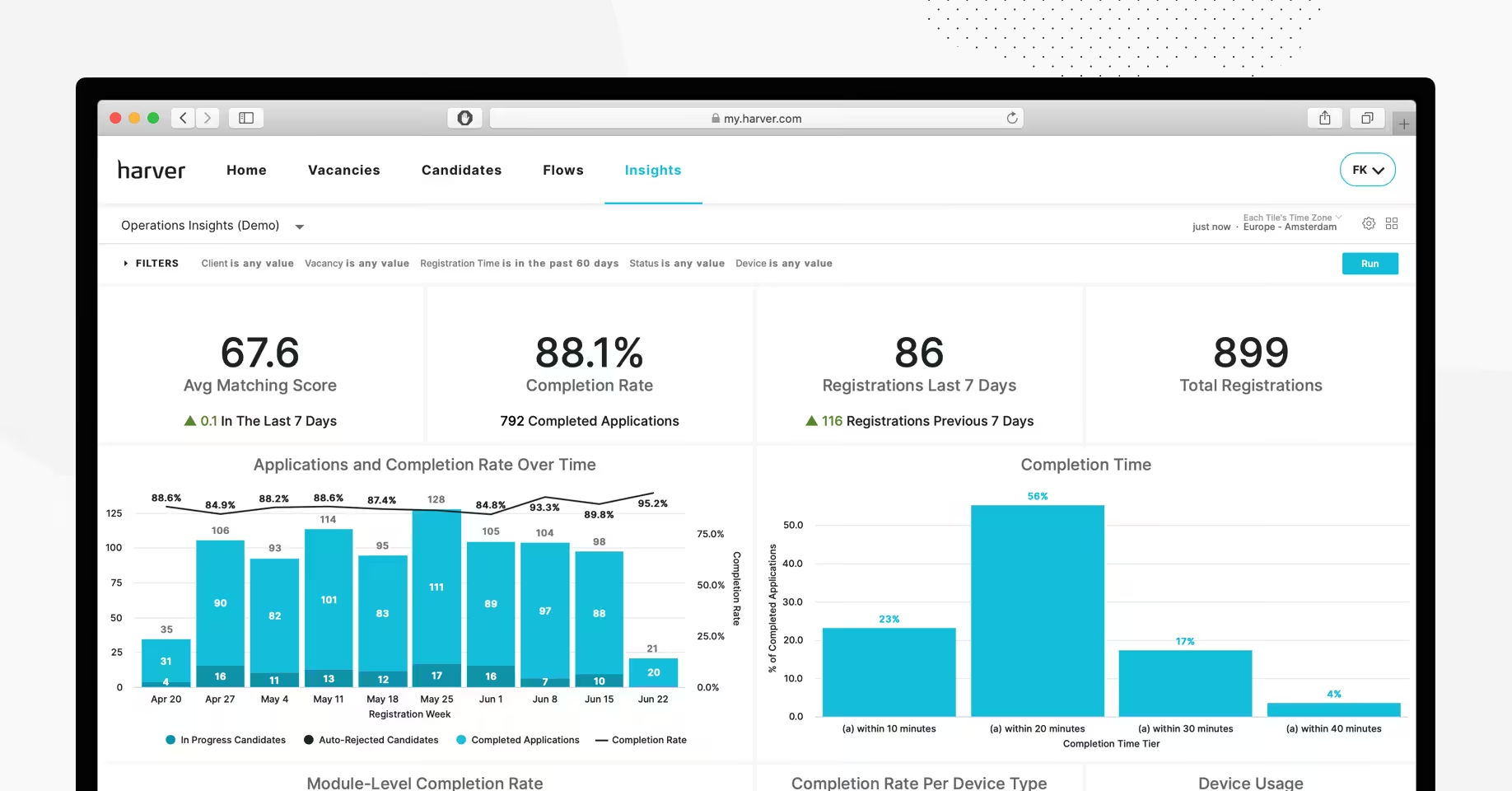
Users see both value and a trade-off in Harver's structured approach.
G2 users highlight Harver’s detailed reporting and role-matching capabilities, while one Gartner reviewer praised its expertise but found it “a little difficult to add some qualitative perspective” to initial screening.
What Harver Does Well
- Gives recruiters hundreds of options to select. A test library spanning hundreds of assessments lets teams evaluate different attributes, then go one-by-one to match profiles and compare candidates against role requirements.
- Automates decisions at high volume. Candidate status can change automatically based on scores or matching brackets.
- Lots of metrics and individual scores. Dashboards provide recruiting teams with data-driven insights into candidate performance, hiring efficiency, and platform usage throughout the process.
Vervoe
Vervoe is an AI-powered assessment platform built around tasks that show how candidates perform.
Assessments can include written responses, videos, audio, spreadsheets, coding challenges, simulations, and presentations, with AI grading used to rank submissions automatically.
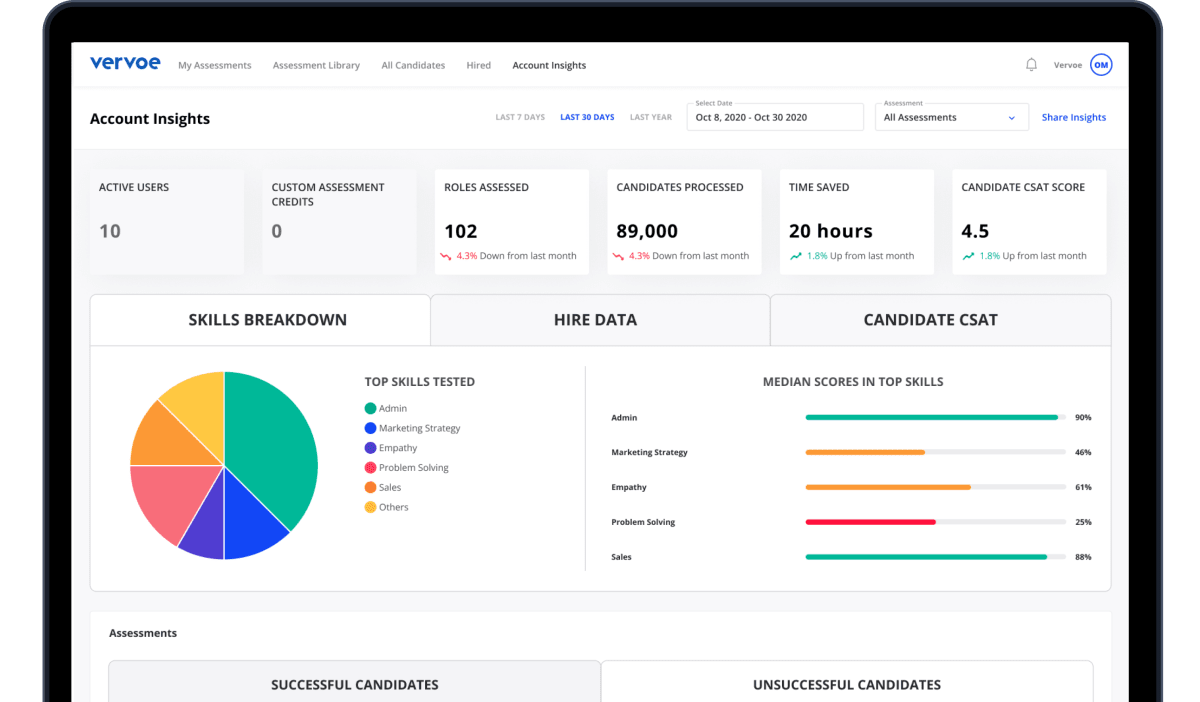
Vervoe’s strongest differentiator is its flexibility. HR professionals can start from its assessment library, generate an assessment from a job description, or build one from scratch, then tailor the scoring criteria to the role. This does mean that hiring teams have to know which skills are tied to performance outcomes in advance.
And configuration matters. One G2 reviewer described the AI as “very effective when trained,” reinforcing that automated grading still benefits from thoughtful early setup and expert oversight.
What Vervoe Does Well
- Evaluate candidates through exercises. Candidates complete tasks across multiple formats rather than relying solely on conventional screening.
- Automates scoring at scale. AI grades responses and produces ranked shortlists without requiring recruiters to manually review every submission.
- Supports tailored assessment design. Teams can customize tasks, skills, weighting, and grading criteria around individual roles.
Sapia.ai
Sapia.ai is a conversational chat AI interview platform that turns role requirements into structured screening at scale.
Sapia.ai’s job agent, Jas, helps the recruitment team weigh the competencies that matter for a role, while its chat interview scores candidate responses against those criteria.
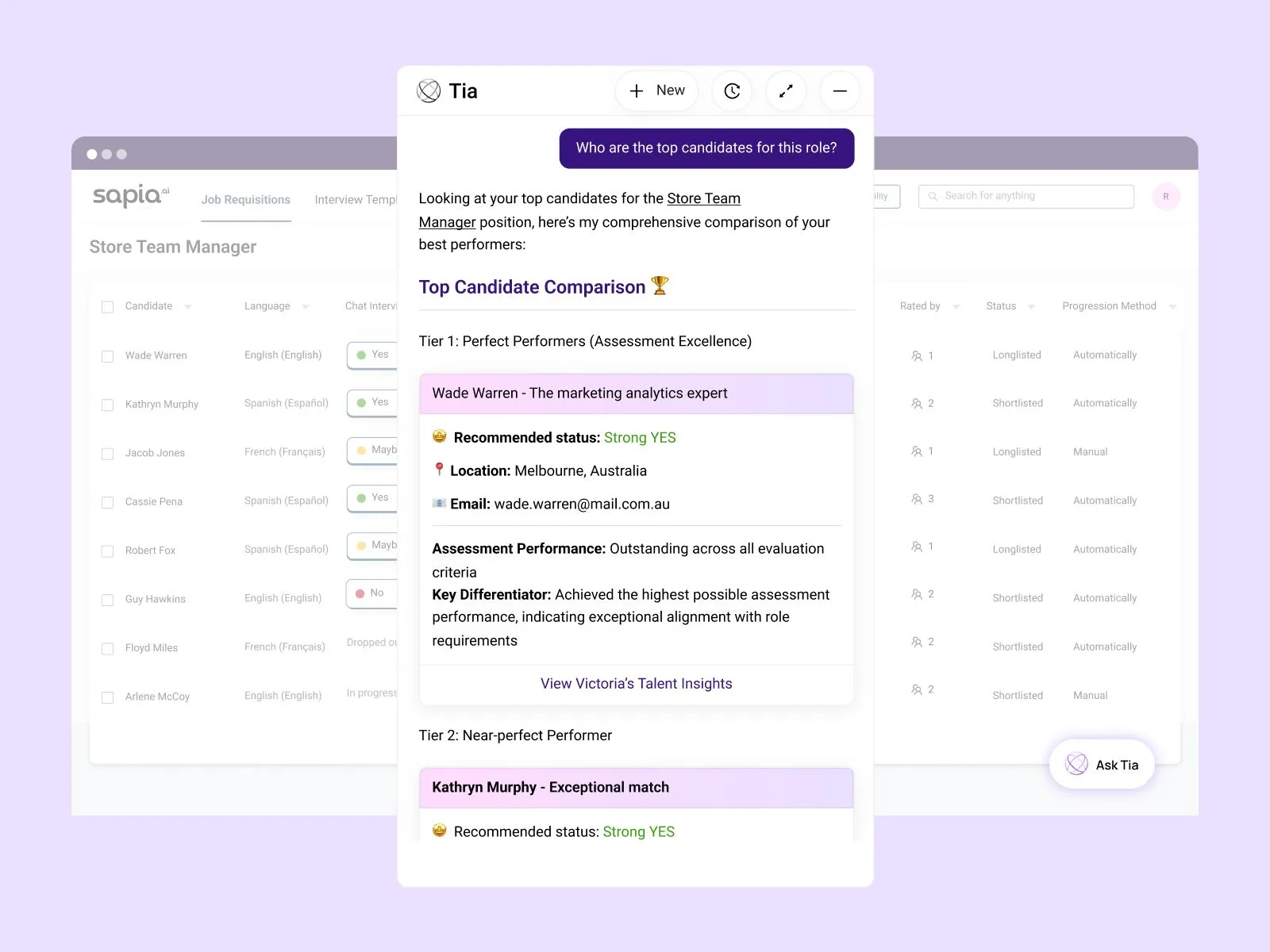
Candidate experience can vary with AI-led screening, making transparency and clear communication important when automated interviews sit in the early hiring stages.
What Sapia.ai Does Well
- Builds competency models. AI agents map jobs to weighted competencies and structured interview questions.
- Screens consistently through chat. Candidates answer the same questions against predefined scoring criteria.
- Automates shortlisting. Interview data is used to identify and compare suitable candidates.
Willo
Willo is an asynchronous screening platform that helps hiring teams replace early phone screens with structured responses that candidates complete in their own time.
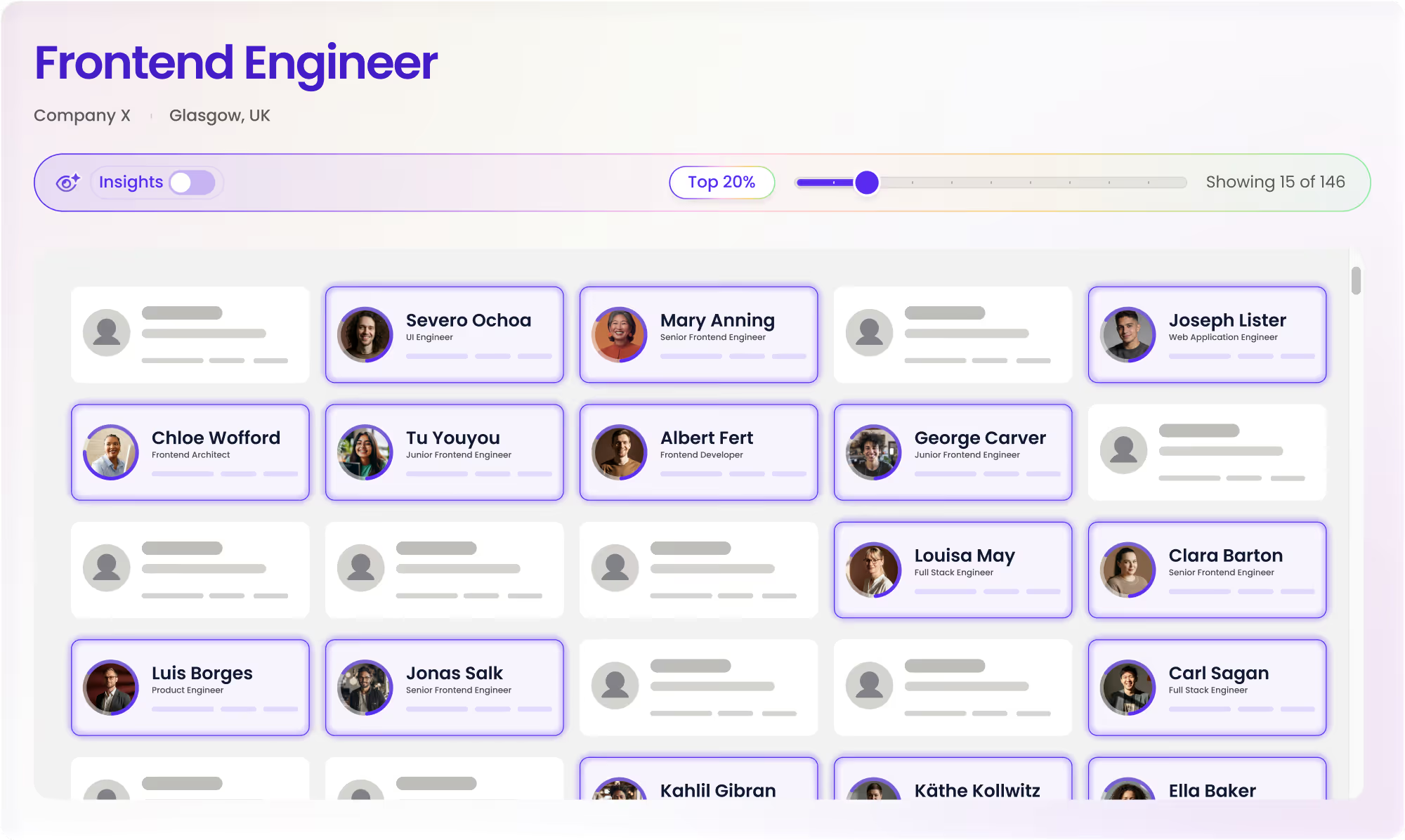
That flexibility can make high-volume screening easier to coordinate.
According to Willo’s published case study, Madison Reed doubled candidate response rates and cut time-to-hire for stylists from more than 30 days to under 15 after adopting Willo. The format, however, will not suit every candidate equally.
G2 reviewers praise the convenience and consistency of asynchronous screening, while some describe one way video interviews as less personal than speaking with someone live.
What Willo Does Well
- Structures first-round screening at scale. Teams use consistent questions while candidates respond without scheduling a live call.
- Adds candidate identity verification. Willo Verified® supports identity and right-to-work checks during screening.
- Fits into existing hiring systems. Willo offers native integrations with ATS and HR platforms such as Greenhouse and Teamtailor, and more.
How to Choose the Right Candidate Assessment Software
The six platforms take different approaches to assessment, so choosing the right one comes down to how reliably it measures the skills you need, handles your hiring volume, and fits your existing process.
Use these five questions to compare platforms against the roles, volume, and workflows your team actually manages.
1. Does It Test Real Job Performance?
Look for evidence that assessment scores predict on-the-job performance, not just performance on the assessment itself.
Public validity research is limited, so ask vendors how scores correlate with measures such as quality ratings, attendance, retention, or other job outcomes.
HiringBranch, for example, found that below-standard scorers in its Just Press One customer study were 63% more likely to be absent.
Providers should be able to demonstrate a documented link between assessment results and performance in the roles they are being hired for.
2. Can It Handle Your Hiring Volume?
High-volume screening should stay efficient without creating unnecessary candidate drop-off.
Assessment length alone does not explain abandonment. Relevance, communication, timing, and mobile usability can all create friction. Instead of relying on one headline completion rate, ask vendors for:
- Invitation-to-start rate. How many invited candidates begin the assessment.
- Start-to-completion rate. How many of the candidates who begin actually finish.
Together, those numbers show where candidates are dropping out of the process.
3. Does It Fit Your Existing Hiring Process?
The software should reduce workarounds in initial candidate screening and fit cleanly into the existing process.
Check whether it integrates with your ATS, returns scores to candidate records, and can automate next steps. For high-volume teams, a small manual task becomes significant when it repeats across hundreds or thousands of applicants.
4. Is It Built for the Roles You're Actually Hiring For?
Match the assessment to the behaviours required by the job.
Customer-facing roles may require candidates to clarify ambiguous requests, adapt explanations, respond appropriately to frustration, or make sound, data-driven hiring decisions under pressure.
Role-specific design has some research support.
A 2022 peer-reviewed salesperson-selection study used job-relevant exercises, including sales role-plays, and reported a true-score criterion validity of .49 for objective sales performance one year later. Since the study focused on sales roles, use it as directional evidence and ask vendors for validation specific to the roles you hire for.
5. Is It Resistant to AI-Assisted Cheating?
Ask how the platform protects assessment integrity and what happens when suspicious behaviour is detected.
Look for multiple integrity signals, clear review procedures, and human audit trails instead of relying solely on a single automated cheating score. A flag should prompt investigation, not automatically determine a candidate’s outcome.
Can Candidates Cheat Assessments With AI?
AI-assisted cheating is now a real assessment-design problem, especially when candidates can submit polished answers without demonstrating the skill themselves.
Capterra’s 2024 survey of 2,997 job seekers across 12 countries found that 58% had used AI during their job search. Among AI users, 83% said they had used it to exaggerate or lie about their skills on a resume, cover letter, job application, or skills assessment. In comparison, 29% of all respondents had used AI to complete a test assignment or skills assessment.
Static, self-reported formats are particularly vulnerable because candidates can feed a written prompt into an AI assistant and receive a stronger answer than they could produce independently.
Assessment platforms generally address that risk in two ways:
- Protect the assessment environment. Proctoring, plagiarism detection, and identity verification can authenticate candidates, restrict access to AI assistants, and flag suspicious behaviour for review. Combine identity verification with real-time monitoring and AI-use detection.
- Open-ended generative assessments. Use interactive, scenario-based assessments that generate a new set of questions for every candidate and require open-ended responses. Because there's no single right answer, candidates have to apply their skills as the situation unfolds, which makes it much harder to just produce a polished, pre-rehearsed response.
Neither approach eliminates fraud entirely.
The stronger standard is to combine relevant assessment design with multiple integrity signals, then use suspicious activity to trigger human review before any rejection is made.
Ask for the bias audit too. A platform that flags candidates automatically should be able to show independent testing of how those flags fall across different groups.
Final Thoughts
For customer-facing, high-volume hiring, the strongest assessments measure communication, judgment, and job-specific behavior in ways that reflect the work candidates will actually do.
The same standard should hold across the rest of the buying decision. Scores need credible validation, workflows need to support hiring at scale, and assessment integrity needs to withstand the growing use of AI.
A strong platform should leave hiring managers with evidence they can understand, defend, and use confidently when deciding who moves forward.
Image Credits
Feature Image: Unsplash/Joseph Frank
Image 1: Property of HiringBranch. Not to be reproduced without permission.
Image 2: Via HireVue
Image 3: Via Harver
Image 4: Via Vervoe
Image 5: Via Sapia.ai
Image 6: Via Willo

.avif)




.svg)