



Learn how skills test software helps high-volume teams screen faster, improve hiring consistency, and predict real job performance reliably at scale.
Subscribe to our Newsletter
Like what you're reading? Leave us your email, and we'll deliver to your inbox on the last Thursday of the month.
When hiring at scale, creating and administering skills tests manually quickly becomes unmanageable. Teams struggle to apply the same evaluation standards across large applicant pools. Candidate comparison becomes less objective, and decisions are harder to justify.
Skills test software helps close that gap. It embeds structured, job-relevant evaluation directly into the hiring workflow. This way, teams no longer rely on fragmented or manually administered assessments. Instead, they use a centralized platform to consistently and efficiently evaluate candidate skills.
This guide explains how high-volume teams use skills test software and what to look for when evaluating a testing platform.
How High-Volume Hiring Teams Use Skills Test Software
High-volume hiring teams use skills test software to deliver structured, job-relevant assessments at scale, allowing them to:
- Access pre-built, role-aligned assessments without creating or maintaining their own tests
- Deliver structured skills evaluation consistently across large applicant pools
- Automate assessment delivery, scoring, and candidate progression to improve time-to-hire
- Standardize evaluation criteria across recruiters, locations, and hiring managers
- Assess applied skills through simulations and role-based scenarios
- Reduce interview bottlenecks by advancing only candidates who meet defined thresholds
- Support the candidate experience with mobile-friendly, time-bound assessments
- Provide structured, comparable results that inform interview outcomes and final decisions
Skills test software replaces disjointed testing practices with a streamlined assessment process. In doing so, it reduces administrative overhead while improving hiring consistency.
Common Types of Skills Tests and When to Use Them
The right skills test for each hiring scenario depends on the role, the required skills, and how the assessment fits within the hiring workflow.
Here’s a breakdown of the most common types of skills tests and their role in high-volume recruitment.
Knowledge-Based Skills Tests
Knowledge-based tests validate baseline understanding across large applicant pools. They’re commonly used to assess knowledge of compliance, product familiarity, or role fundamentals.
These assessments are efficient and easy to scale. However, candidates can often prepare for them by memorizing answers or studying common question banks. As a result, a high score doesn’t always indicate genuine understanding or real-world capability. Multiple-choice formats also allow for educated guessing.
Knowledge-based tests can be effective for evaluating foundational knowledge, but not for predicting on-the-job behavior.
Technical Skills and Coding Tests
Technical skills tests evaluate candidates’ applied problem-solving abilities in specific domains such as coding and data analysis. Many organizations also use these pre-employment tests to assess proficiency with tools such as Microsoft Excel.
For engineering, finance, and operations roles, technical skills tests are often necessary to confirm proficiency. They show whether a candidate can complete a defined task under structured conditions.
However, technical tests are typically time-intensive and narrow in scope: they assess whether a candidate has the coding skills or technical abilities to complete a specific task. They don’t evaluate soft skills like sound judgment, communication, or adaptability within the full job context.
Video Interviews
One-way video interviews allow candidates to record responses to predefined questions. Then, hiring teams review those recordings asynchronously.
Video can provide insight into communication style and presence, particularly for customer-facing roles. However, this interview method can be time-consuming for hiring teams and also relies heavily on human interpretation.
As a result, video interviews shouldn’t be used as an unstructured screening tool. They are most effective when combined with objective evaluation standards, including clearly defined scoring criteria or specific behavioral indicators.
Job-Specific and Simulation-Based Skills Tests
Simulation-based assessments replicate real work scenarios. Candidates complete structured exercises that reflect actual tasks, decisions, and trade-offs they would encounter on the job.
These assessments are contextual and open-ended. As a result, they’re harder to cheat and better aligned with day-to-day performance. Job-specific skills tests allow hiring teams to evaluate multiple competencies at once, including problem-solving, prioritization, and soft skills.
Simulation-based testing is particularly effective in high-volume hiring when the goal is to assess applied ability rather than theoretical knowledge.
Voice-Based Skills Tests
Voice-based skills tests assess how candidates communicate in job-relevant verbal scenarios. Candidates respond aloud to structured prompts that reflect real conversations they would have on the job.
Unlike written or multiple-choice formats, voice-based assessments capture how candidates express tone, empathy, acknowledgment, clarity, and fluency in context, standardizing how recruiters evaluate spoken responses. This functionality allows teams to assess real-world communication at scale without relying solely on live interviews.
In high-volume hiring, voice-based testing is especially valuable for customer support, contact center, and retail roles.
Key Features to Look for in Skills Test Software
The right skills assessment software supports scale, fairness, and operational efficiency without adding complexity to high-volume hiring workflows.
Here are six essential features to consider when reviewing skills test software.
1. Job-Relevant Assessments
Look for a skill assessment platform that evaluates candidates through tasks that mirror real job responsibilities.
Some platforms offer large libraries of pre-built tests covering common knowledge areas such as compliance, product knowledge, or tools like Excel. While these can validate baseline knowledge quickly, they often measure theoretical understanding rather than actual job performance.
For high-volume hiring, prioritize platforms that support role-specific assessments or simulations tied to actual job tasks. When assessments mirror realistic work scenarios — such as responding to customer scenarios, completing operational workflows, or solving role-based problems, they provide stronger signals about candidate competency, capability, and long-term performance.
2. Role-Level Customization and Control
The platform should support the creation of custom tests or fully custom assessments tailored to your organization’s specific requirements. You should be able to define the competencies to measure, adjust score weighting, and set progression thresholds that align with your hiring criteria.
This level of control allows hiring teams to apply consistent scoring standards across large applicant pools while matching assessments to each role’s requirements.
3. Reporting and Analytics for Better Hiring Decisions
Look for reporting that provides deeper insights than simple pass-or-fail scores. The platform should break down performance by competency and provide structured, comparable results for each candidate.
Clear analytics allow hiring teams to understand how assessments influence candidate progression decisions and where criteria may need refinement.
Strong reporting functionality ensures your evaluation standards remain transparent and defensible as hiring volume increases.
4. Proctoring and Anti-Cheating Controls
Confirm that the assessment platform includes built-in proctoring and anti-cheating features that are appropriate for the assessment type.
Note: Proctoring tools monitor the testing environment to ensure candidates complete assessments independently and under the required conditions.
Depending on the test, proctoring and anti-cheating measures may include:
- Time limits to reduce opportunities to look up answers or collaborate with others
- Question randomization so candidates receive different question sequences, limiting answer sharing
- Browser controls that restrict switching tabs or opening external resources during the test
- Identity verification to confirm that the person completing the assessment is the applicant
- Safeguards against answer sharing and outside assistance
Reliable proctoring tools help teams maintain confidence in assessment data without introducing excessive applicant monitoring or friction.
5. Integration With Your ATS
Ensure the platform connects directly with your applicant tracking system so assessment data flows automatically into candidate records.
Recruiters should be able to trigger assessments, review structured results, and advance candidates within their existing workflow, without switching between disconnected tools.
Strong integration makes skills testing part of your hiring process, not an extra layer of administration.
6. Real-Time Scoring and Structured Results
Look for a platform that applies standardized scoring criteria automatically and presents results in a clear, structured format.
Hiring teams should be able to compare candidates using consistent data rather than manually interpreting unstructured responses.
Standardized results allow you to evaluate large applicant pools using consistent, comparable data across the board.
How to Choose the Right Skills Test Software for High-Volume Hiring
Choosing the right skills test software depends on the roles you hire for, the scale you operate at, and the hiring challenges you want to address.
Here are six practical tips to help hiring teams evaluate online skills assessment software based on these principles.
1. Identify Where Skills Tests Fit in Your Hiring Process
The right skills test software should align with the specific stage of the hiring process you’re trying to improve.
Before evaluating vendors, clarify what problem you’re aiming to solve. Are recruiters overwhelmed by early-stage applicant volume? Are interviews inconsistent across hiring managers or locations? Is your current approach to candidate assessments adding friction to the hiring process or failing to improve employment decisions?
Some platforms support high-volume, early-stage screening, where speed, automation, and consistent scoring are most critical. Other solutions are better suited to mid-stage evaluation, where hiring managers need clear competency data to guide interviews and compare good-fit candidates fairly. A few skills test platforms are designed for deeper technical or role-specific validation.
Avoid this common mistake: Adding skills tests too late, which duplicates resume screening or interviews instead of replacing them.
The right software should clearly support the hiring stage you want to strengthen and reduce manual effort or inconsistency at that point in the process.
2. Match the Software to the Roles You Hire at Scale
Skills test software should match the assessment design with the real tasks and decisions of each role.
For example:
- Frontline and customer-facing positions benefit from job-specific assessments that reflect real interactions and decisions
- Technical or operational roles often require applied problem-solving or role-based exercises
- Soft-skills-heavy roles need structured ways to evaluate communication and judgment
When choosing skills test software, evaluate whether the platform supports role-specific assessment types rather than a single format.
Avoid this common mistake: Using generic or one-size-fits-all skills tests that don’t reflect real job requirements.
The right solution should enable you to assess the skills that directly influence performance in each role.
3. Assess How the Software Measures Real-World Performance
When candidates respond to realistic, role-based scenarios, their assessment surfaces how they apply judgment, communication, and problem-solving in context.
By evaluating applied ability rather than abstract knowledge, hiring teams gain clearer insight into which candidates are likely to succeed and stay in the role.
Research supports the link between job-relevant assessment and long-term hiring outcomes. A study by The Burning Glass Institute found that when organizations align hiring practices to job-relevant skills, two-year retention improves by 10 percentage points.
Avoid this common mistake: Relying exclusively on multiple-choice or psychometric tests that lack real-world relevance.
As one HiringBranch customer found, the impact on quality of hire is significant when pre-employment assessments reflect real work. Sarah Wise, Operations Director at Fundraising Direct, told CX Today:
“Because we have the skill set at the point of recruitment, the minute the new telephone fundraiser hits the phones, the quality is fantastic.”
With this in mind, look for software that allows you to design or configure assessments around the real tasks, tools, and decision-making scenarios that define success in each role.
4. Evaluate the Candidate Experience at Scale
In high-volume hiring, the candidate experience influences who stays in your pipeline and how your employer brand is perceived.
Assessments play a central role in that experience. Candidates can tell a well-designed skills test that feels relevant and clearly connected to the job from a poorly designed test that feels long, repetitive, or disconnected from real work.
When tests are clear and easy to complete, applicants are more likely to remain engaged in the hiring process. When they’re overly long or complicated, strong contenders may drop off without progressing further.
Avoid this common mistake: Creating a poor candidate experience by stacking multiple assessments without a clear purpose.
To protect the candidate experience, skills test software should provide assessments that are clear, relevant, and accessible on any device.
5. Look for Automation, Integrations, and Operational Fit
The right skills test software should fit seamlessly into your existing hiring systems, allowing teams to automate screening and data flow without creating extra work.
In the example below, the hiring team uses a proprietary API to create a direct connection between its ATS and its skills test software:
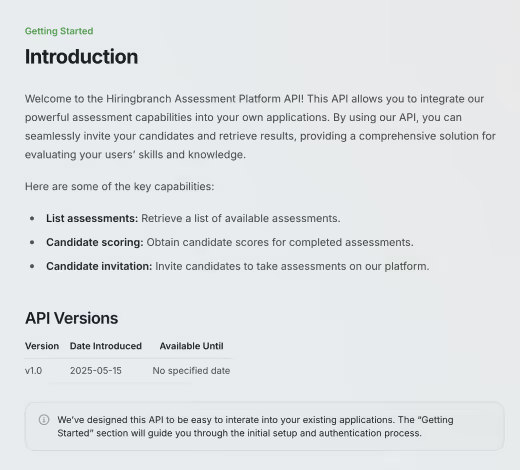
Recruiters can trigger an online skills assessment test from within the ATS, view results inside the candidate profile, and use standardized scores to move applicants forward or disqualify them without switching platforms.
Avoid this common mistake: Choosing an assessment tool that operates in isolation and creates additional manual work instead of streamlining the hiring process.
These system integrations help streamline candidate assessments by integrating them directly into your hiring operations.
6. Weigh Up Pricing, Scalability, and Long-Term Value
The skills test software you choose should scale with applicant volume and support expansion across roles and locations. It should also adapt as your hiring strategy evolves.
As part of that evaluation, review how each pricing model scales over time. In high-volume environments, per-candidate or per-assessment costs can compound quickly, so it’s important to understand how the total cost could change as your hiring demand increases.
Avoid this common mistake: Optimizing for the lowest upfront price without accounting for long-term volume costs. Short-term savings often limit future flexibility.
The right software should combine transparent pricing with the flexibility to support long-term hiring growth.
How Voice-Based Skills Tests Make Communication Skills Measurable
In high-volume hiring, spoken communication often determines on-the-job performance. Voice-based skills tests allow teams to evaluate performance early in the hiring process, using structured scoring rather than live interviews alone.
Case study: Telecommunications company Bell Canada used HiringBranch to introduce skills testing earlier in the recruitment process. The team now spends less time interviewing candidates because the tests reveal such a strong correlation between assessment scores and high performance.
Veronique LaCasse, Senior Recruiting, Training & Onboarding Manager, describes the result as “a win on cost, efficiency, and productivity.”
Tools like Job Skills Screen make it easy for hiring teams to assess candidates’ real-world communication skills. In the example below, HiringBranch evaluates a candidate’s verbal response to a customer support scenario:
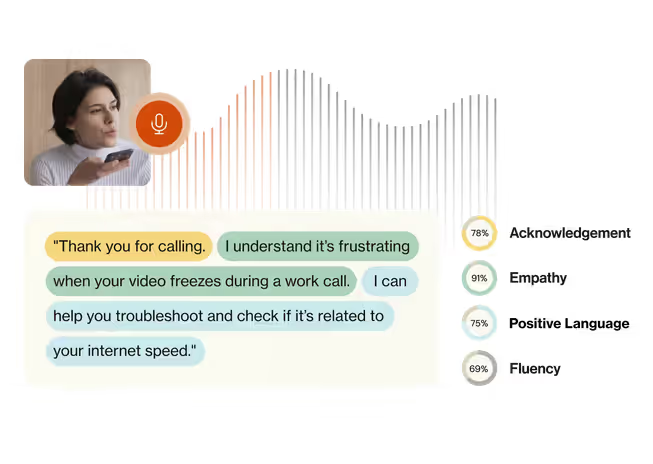
The AI-powered software transcribes the candidate’s response and scores defined competencies such as acknowledgment, empathy, and positive language. The tool produces standardized percentage results tied to each skill.
These structured results feed directly into the hiring workflow. Recruiters can view competency scores, compare candidates using consistent data, and automatically advance those who meet predefined thresholds — all within a single dashboard. Communication performance becomes visible and actionable early on.
By making communication measurable, voice-based testing allows teams to evaluate candidates’ real skills before their first live interview.
The Strategic Role of Skills Test Software in High-Volume Hiring
High-volume hiring works best when evaluations are clear, consistent, and tied to real job requirements.
With the right skills test software, hiring teams are better positioned to identify top talent based on proven capabilities. The tools embed structured assessments directly into the hiring workflow to reduce administrative burden, improve interview quality, and create shared evaluation standards among recruiters and hiring managers.
Over time, assessment data helps teams refine hiring criteria and reduce early attrition as application volume grows. Learn how our hiring assessments allow you to measure role-critical skills with 98% accuracy.
Image Credits
Feature Image: Via Unsplash / Vitaly Gariev
Image 1, 2: Property of HiringBranch. Not to be reproduced without permission.
Skills Test Software FAQs
Skills test software evaluates demonstrated job skills, while talent assessments take a broader view of a candidate’s traits and long-term potential. As a result, talent assessments sometimes include personality, cognitive, or behavioral components.
Skills test software doesn’t replace interviews, but it can reduce how many interviews hiring teams need to conduct.
By screening for the right candidate skills early, recruiters can identify good-fit applicants to take to interview. With fewer candidates to meet with, hiring teams can have more productive conversations during the interview process.
When recruiters spend more time administering, reviewing, or chasing assessments than engaging with qualified candidates, skills test software can help by streamlining and standardizing the process.






.svg)