



Recruiters have spent the last few years hearing that AI would make hiring faster, fairer, and easier to scale. What's landing in court dockets right now is telling a different story.
Subscribe to our Newsletter
Like what you're reading? Leave us your email, and we'll deliver to your inbox on the last Thursday of the month.
Mobley v. Workday is a case the industry has been watching closely. Filed in 2023, it alleges Workday's AI screening tools discriminated against candidates by age, race, and disability across a platform that processed roughly 1.1 billion job applications. In May 2025, a federal court certified a nationwide collective covering every applicant over 40 denied a recommendation through Workday since September 2020, and the case has continued moving through discovery ever since. This class action case is built entirely on how an AI system scored people, and it’s not the only situation like this.
In 2023, the EEOC settled its first-ever AI hiring discrimination case against iTutorGroup, which had programmed its recruiting software to automatically reject women applicants aged 55 and older and men 60 and older. The company paid $365,000, which is a small settlement, but sets a big precedent. The federal government confirmed that an algorithm making the call doesn't change who's liable when it discriminates.
The regulatory net is tightening just as fast as the case law. There are now 29 separate regulations tracked across 25 jurisdictions specifically governing AI in hiring and employment, alongside six active pieces of litigation, according to Warden Watch, a new live tracker built to catalogue AI hiring regulation and lawsuits as they happen. In the US alone, that's 21 regulations and counting. Recruiters can’t afford to ignore explainability. It's already on their doorstep, and it's moving fast enough that compliance teams are struggling to keep up.
"The AI Said So" Isn't a Defense
Most AI hiring tools were never built to explain themselves. They output a score, a ranking, or a star rating, and that's it. When a candidate asks why they were screened out, or a regulator asks how a tool was validated, "the algorithm decided" isn't an answer.
Candidates deserve to know a decision about their livelihood was made on defensible, evidence-based grounds, not a black box. And recruiters deserve the same thing, but for a different reason. When a hiring decision gets challenged, whether by a rejected candidate, a client, or a regulator, the recruiter is the one who has to answer for it. An audit-ready explanation is the only thing standing between a recruiter and personal exposure to a claim they can't defend.
NYC's Local Law 144, which went into effect in July 2023, requires employers using automated hiring tools to complete an independent bias audit every year, publish a summary of the results, and give candidates advance notice before the tool is used. The EU AI Act goes further, classifying recruitment, candidate evaluation, and related employment decisions as "high-risk" AI use cases outright, which brings mandatory risk assessments, human oversight, and a right to explanation for anyone affected. Regulators on both sides of the Atlantic have concluded that if you can't explain a hiring decision, you shouldn't be allowed to automate it.
What to Actually Expect From an AI Hiring Tool
Given all of this, the line of questioning for an AI hiring vendor has changed. To help every recruiter prepare their checklist, here’s some things to consider before trusting an AI tool.
How does the tool account for variability in decisions and silent drift in the AI model?
Tools built on top of OpenAI, Gemini, or another off-the-shelf model inherit that model's silent version updates and shifting outputs. A model that scores a candidate differently depending on which week you ran the assessment cannot produce a defensible, repeatable result, and closed-source LLMs update on their own schedule, not yours. Make sure to use a private, purpose-built model, not a general-purpose LLM wrapper.
How is the AI tool audited?
Independent bias audits need to be completed and published. This is now a legal requirement in multiple jurisdictions.
What audits can the tool provide?
The tool should also provide an audit trail. That way, every score should trace back to specific, observable evidence, not a holistic impression a model generated on the spot.
How does the tool account for determinism in decision making?
The AI tool selected for the hiring process should be able to take the same candidate and evaluate them the same way twice, and get the same result. If a tool can't guarantee that, it can't be defended in front of a regulator or a rejected candidate.
Explainability Just Got Even Better at HiringBranch
We recently upgraded candidate profile scores at HiringBranch to put clear and defensible evidence directly in front of recruiters. Every HiringBranch report now opens into a full candidate profile that includes the overall score, a plain-language explanation of what drove it, the specific observed behaviors behind each competency, and how the candidate measured up against what the role actually requires. It's structured and visual, which means it holds up for a recruiter if they were ever challenged on their hiring decision.
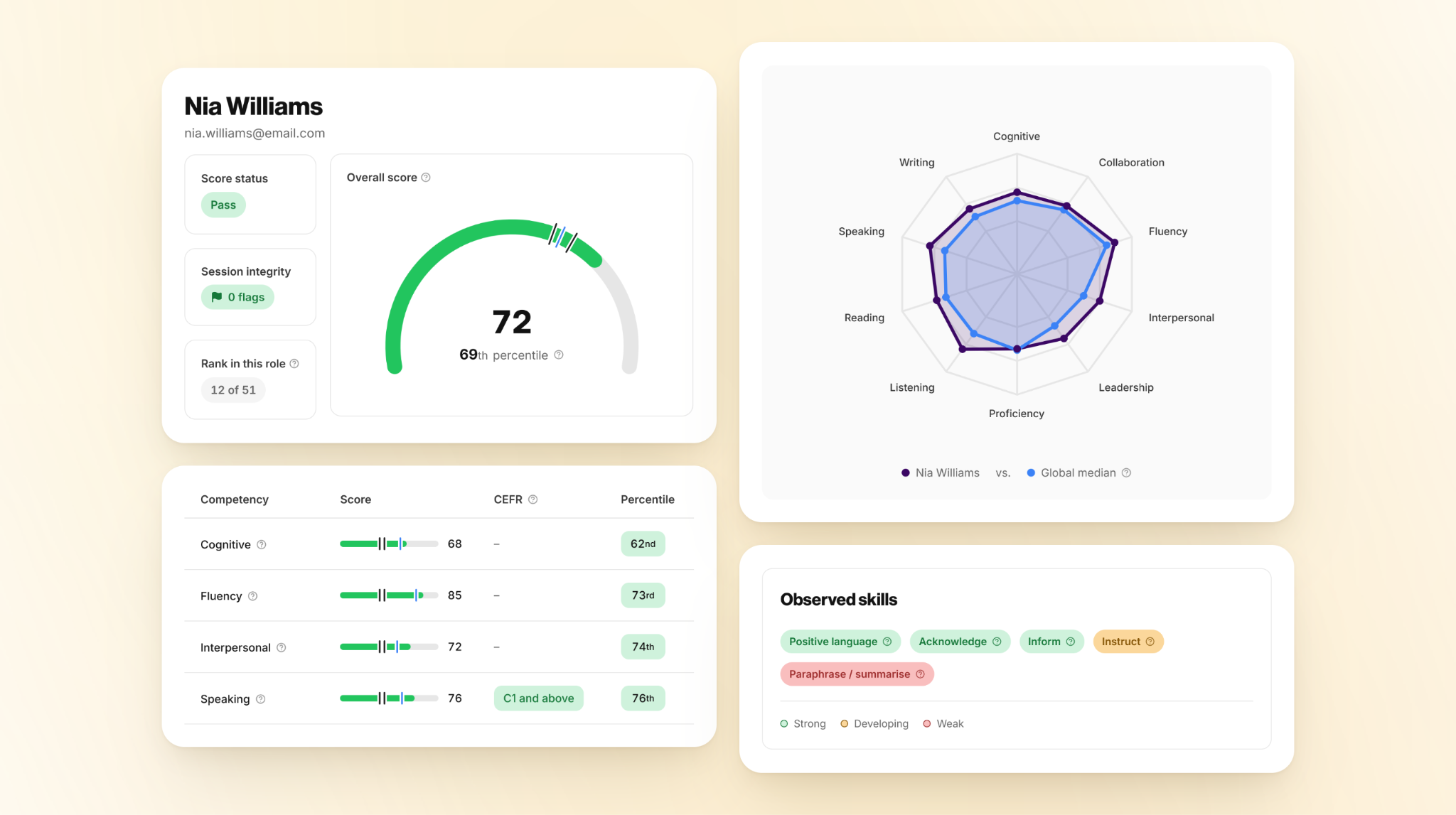
Explainability at HiringBranch is backed by two things that matter most. First, our scoring is bias-audited and SOC 2 Type II certified, with accuracy independently measured at 98%. Second, our engine measures skills simultaneously because our research shows that skills are far more reliably measured in combination than in isolation. Competence shows up in how skills combine, sequence, and adapt within a single conversation. As our latest ebook explains “Workplace communication is not a checklist of isolated soft skills. It’s a sequence of decisions and behaviours in real conversations and should be measured that way.”
Every score is placed against candidate data from around the world and validated against real on-the-job performance outcomes.
Beyond explained scores in candidate profiles there are global percentiles. Our Chief Research & Development Officer explains “The HiringBranch Standard is a global benchmark for language, communication, and cognitive skills. Every score is placed against candidate data from around the world and validated against real on-the-job performance outcomes. A percentile tells you exactly where someone stands, not just whether they passed.”
The Expectation Around Explainability
Every hiring decision depends on the accuracy of the assessment behind it, whether that assessment is automated or manual. The difference is whether you can explain it when it's challenged.
Recruiters need to be asking tough questions to make sure that they stay compliant with their regional hiring requirements. And be mindful that these types of regulations are emerging constantly, as hiring AI tools evolve alongside.
To learn more about how explainability at HiringBranch's works click here.
Image Credits
Feature Image: Unsplash/LOGAN WEAVER | @LGNWVR
Image 1: Property of HiringBranch. Not to be reproduced without permission.




.svg)