If hiring were a science, most recruiting professionals would be fired. Hot take, I know, but it's warranted, since most hiring methods fail the basic validity test.
Subscribe to our Newsletter
Like what you're reading? Leave us your email, and we'll deliver to your inbox on the last Thursday of the month.
In 2022, Paul Sackett and colleagues re-analyzed decades of selection research and found that earlier meta-analyses had overcorrected their numbers, inflating the validity of almost every hiring method. SIOP's summary calls it a course correction for the field. When the dust settled, structured interviews ranked first (ahead of cognitive ability tests, which had held the top spot for 50 years). That sounds like good news for structured interviews, but it was with a validity of .42.
That means the most reliable mechanism for hiring is the interview, and yet it can only account for 18% of the differences in how people later perform (.42 squared). The other 82% goes unexplained. And that .42 figure is the average. In reality, most TA teams have no valid measure of a candidate before they make a hiring decision.
Here is what the evidence says, and what to do about it.
Unpacking Interview Validity in the Hiring Process
When it comes to deciding who should be hired for a job, there should be a standard method applied to the process that predicts who will perform. In the world of validity, 1.0 would be equal to perfect prediction capability, while a 0 would be a measure that’s no better than random chance.
It’s unsettling that decades of hiring decisions have been analyzed using mechanisms that have at best a validity of .42. And even then, SIOP noted a relatively wide spread around that average, with the best results coming from interviews built on detailed job analysis and run by well-trained interviewers. Most interviews, especially in high-volume hiring, don't meet that bar.
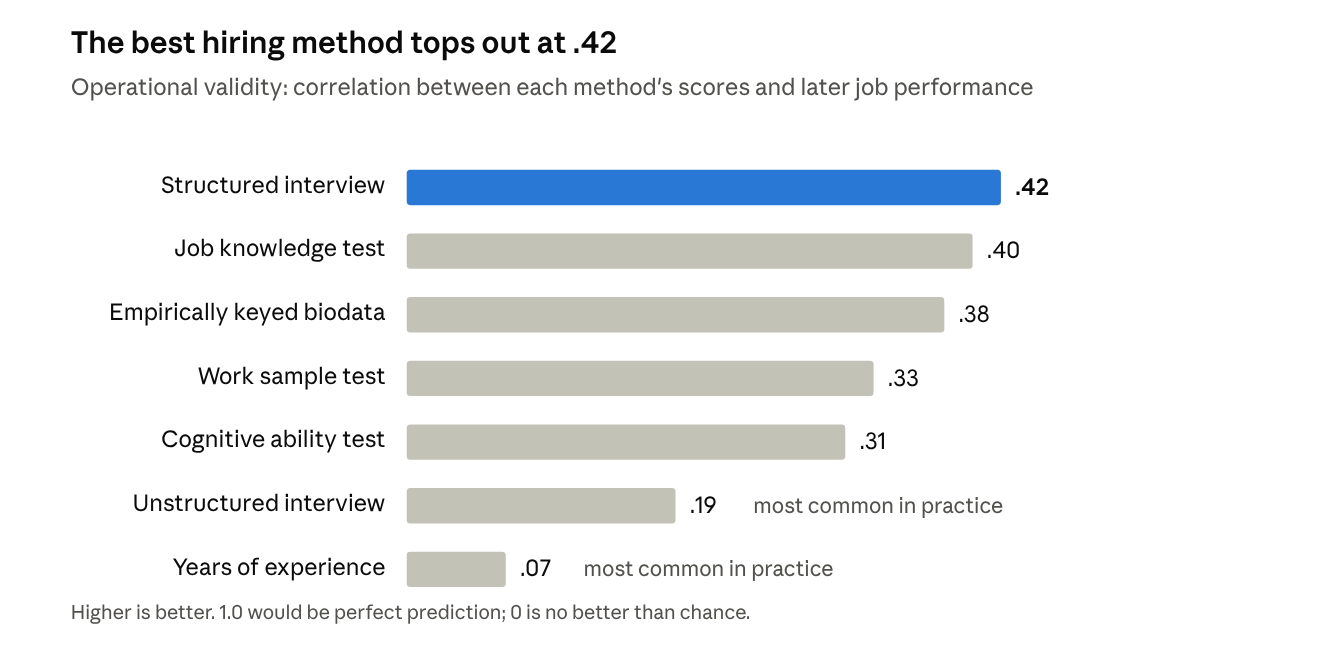
Sackett, Zhang, Berry & Lievens (2022), Journal of Applied Psychology, as summarized in SIOP's TIP. Unstructured interview and experience values from the same paper's Table 3.
Going back to the study that led Sackett, Zhang, Berry & Lievens to revisit the psychological validity, a meta-analysis by Conway, Jako and Goodman (1995) estimated the upper limit of validity at .67 for highly structured interviews and just .34 for unstructured ones, purely because of how inconsistently they are scored. And consistency can relate to the process (methods, technology mechanisms, geographical differences)...or the people.
A later meta-analysis of 125 reliability coefficients covering 32,428 people found interviewer agreement averaged .74 when a panel saw the same interview, but only .44 when different interviewers ran separate interviews. The authors also flagged that even highly structured interviews were less reliable than expected when run separately.
Separate interviews conducted by different recruiters is often how hiring operates, especially for high-volume roles. With hundreds of candidates (or even thousands!), a rotation of interviewers is a more likely reality.
So at .44, two interviewers' ratings of the same person share less than a fifth of their variance. Translation? Even under ideal scoring conditions, an unstructured interview would let through roughly one bad hire in three. A highly structured interview cuts that to about one in six. In practice, both can perform worse than these averages.
How Hiring Actually Gets Done
Claiming that most hiring is operating without any validity seems reductive, but let’s look at some of the data we have. XpertHR found more than a third of employers (37.5%) use just an interview as their only selection tool. The Canadian Psychological Association said, “The job interview is the most commonly used selection method available,” and cautioned in the same article that interviews are susceptible to subjective and arbitrary analysis that leads to bias. In a Monster and UCL survey of 300+ UK recruiters, 73% said they use unstructured interviews, and respondents rated gut instinct the most cost-efficient hiring tool they have.
When gut instinct and interviews are the compass, the results can be subpar. In a CareerBuilder survey of 2,257 hiring managers, 74% admitted hiring the wrong person, at an average cost of $14,900 per bad hire. In frontline roles, that cost compounds. NICE reported average contact center agent attrition of 39% in 2024. For a 100-agent center, 39% attrition means 39 agents leave per year, and at a cost of 15k per agent, that would equal nearly 600k per year in bad hires. If one-third (or more!) of a workforce turns over every year, a weak selection signal gets paid for again and again.
Consistent Scoring Leads to Great Hiring
So far, we’ve spent this article explaining how hiring is not meeting the bar when it comes to validity, and the obvious outcome is bad hires. The good news is you don't need a research team to make that connection, or to raise the signal in your hiring. Here’s a four-step process to make your hiring more scientifically sound:
- Audit what you actually use
If years of experience and conversational interviews drive most decisions, you are relying on the two weakest predictors in the table. Raise your concerns about this process within your team and organization.
- Structure every interview
If you decide to still use interviews, make sure to apply the same job-relevant questions and the same rating scale for every candidate. Where you can, use panels, and combine ratings by formula rather than discussion. Conway and colleagues found multiple ratings only helped when combined mechanically. You should also measure interviewer agreement by having two interviewers score the same recorded interviews each quarter. If they disagree often, fix that before debating which questions to ask.
- Put a consistent signal upstream
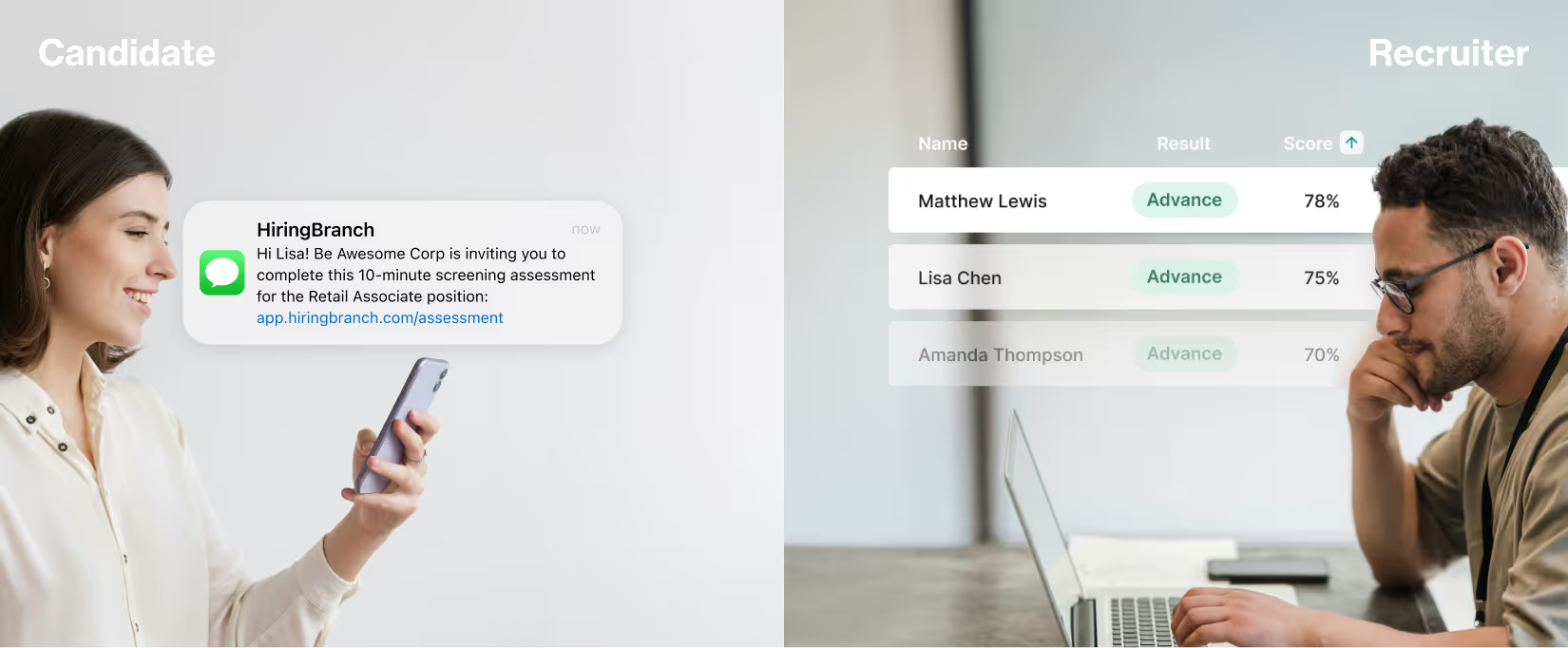
Use skills-based hiring to move away from what a candidate says towards what they can actually do. A skills assessment can give candidates a consistent and unbiased mechanism to demonstrate their skills. For high-volume roles, a job-relevant assessment that scores every candidate the same way gives interviewers a reliable starting point instead of a stack of resumes.
- Ask vendors for two numbers
If you are using or planning to use a tool like AI in the hiring process, ask the vendor how consistently the tool scores (reliability), and how well scores predict performance or retention in roles like yours (validity). A vendor that can only answer one hasn't finished the job.
Hiring will never be perfectly predictable, but it starts with scoring candidates the same way every time.
Image Credits
Feature Image: Unsplash/Marcus Winkler
Image 1: Via Claude Design using data cited by SIOP